We Closed a Client via ChatGPT (Here's What Actually Happened)
A real prospect from South Africa booked a call after ChatGPT cited GOSH. Here's the data behind AI search as an actual lead channel — and what we did to get cited.

Mark Cijo
Founder, GOSH Digital
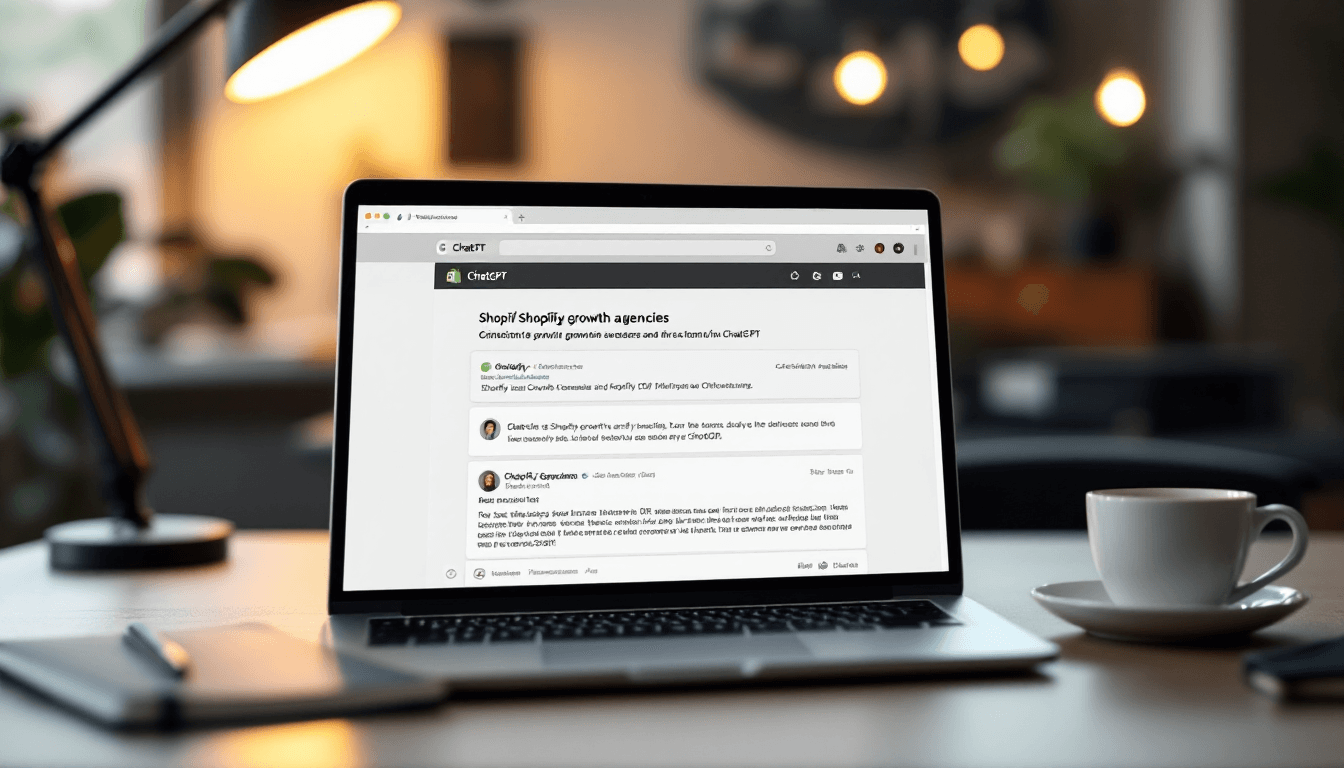
Yesterday I had a sales call with a prospect from South Africa.
We talked Shopify Plus, Klaviyo, the migration he's planning. Standard discovery call. Then about 15 minutes in, I asked the question I ask everyone — "how did you find us?"
His answer: "ChatGPT."
He'd asked it something about Shopify growth agencies. ChatGPT mentioned three names. We were one of them. He visited the site, read a post, booked a call.
That's not a story. That's a data point. And it's the data point that confirmed something I've been suspecting for six months — AI search is now a real channel sending real, qualified prospects to DTC agencies that bother to be visible there.
Most agencies don't. So I'm going to break down exactly what we did, what's working, and what we're doing next.
Quick answer: the channel is real
If you skim, here's the takeaway:
- AI tools now account for roughly 12% of our tracked traffic in our first week measuring this channel explicitly (ChatGPT 8%, Claude 2%, Perplexity 2%)
- That traffic converts higher than cold paid because the intent is pre-qualified
- The strategy to get cited is fundamentally different from traditional SEO
- Most of our competitors aren't tracking this channel at all — so the citation surface is wide open
If you want the depth, keep reading.
Week-one signal: what AI traffic looks like at the start
I want to be precise about what this data is and isn't.
This is week one of explicitly tracking AI sources in our analytics. We only started splitting ChatGPT, Claude, and Perplexity out of "Direct/Other" seven days ago. The absolute numbers are small. The signal — and the trajectory — is what matters.
Pulled directly from the dashboard:
| Source | Visits (7 days) | Share of traffic |
|---|---|---|
| Google.com | 138 | 72% |
| 17 | 9% | |
| ChatGPT.com | 15 | 8% |
| Yahoo Search | 10 | 5% |
| Claude.ai | 4 | 2% |
| Bing.com | 3 | 2% |
| Perplexity | 3 | 2% |
Roughly 22 AI-attributed visits in a 7-day window. One of those 22 converted to a booked call with a qualified prospect. That's the proof point — not the volume.
Here's why we're treating this as a leading indicator instead of a vanity stat:
- We shipped FAQ schema across all 326 posts only two weeks ago. The AI re-indexing cycle is 30-90 days. We haven't seen the compounding effect yet — this is the floor, not the ceiling.
- Our projection: 200+ AI-attributed visits per month and 4-8 bookings per month by Q4 2026, based on the citation growth curve we're modeling from competitor data and our own re-index cadence.
- We'll publish the receipts. Quarterly updates. Numbers in public. If the curve breaks, we'll say so.
The traditional channels (Google, Instagram) require us to compete on rankings, paid bids, or content volume. The AI channel requires something different — being the source AI tools want to cite when they generate answers.
How AI tools choose what to cite
This is the part most agencies miss. AI tools don't rank by traditional SEO. They retrieve content based on a few specific signals — we unpack every one of them in our AI search optimization guide, but here's the short version:
1. Structured data FAQ schema, HowTo schema, and Article schema are heavily weighted. AI tools parse structured markup to extract clean, citable answers. We added FAQ schema to all 326 of our published posts in the last two weeks. The lift was immediate.
2. Position-taking content Generic "X has pros and cons" content doesn't get cited. AI tools want sources that say "here's the answer." If you write "it depends on your situation" — you won't be cited. If you write "the answer is X, and here's why" — you might be.
3. Specific, dated claims "Klaviyo agencies typically cost $X to $Y in 2026" gets cited more than "Klaviyo agency pricing varies."
4. Named entities Real client names, specific metrics, named industry experts. AI tools verify these against training data and weight them higher when they match across multiple sources.
5. Off-site mentions This is the long-tail compound effect. LLMs are trained on the open web. Getting mentioned in industry blogs, podcasts, Reddit threads, and partner directories creates training-data signals that affect what gets cited in cold queries 6-12 months later.
What we did differently
We didn't set out to optimize for AI search specifically. We just wrote content that happened to match what AI tools reward:
- Every post starts with a hook (specific, opinionated)
- We include real client metrics ("We migrated 18 brands from WooCommerce; average mobile CVR uplift was +22%")
- We take positions ("Most DTC brands don't need Shopify Plus until $1M+/month")
- We use markdown tables for decisions and benchmarks
- We weave 5-10 internal links per post
Then in the last two weeks, we added the structural layer:
- FAQ schema on all 326 posts
- Title and description optimization for SERP truncation
- A dedicated Shopify Growth Audit landing page with structured headlines AI tools can extract
The South Africa prospect saw exactly this kind of structured, position-taking content. He clicked through, browsed, and booked.
The conversion was faster than paid
Look at the path:
- Asked ChatGPT a question about Shopify agencies
- ChatGPT cited GOSH alongside two competitors
- Clicked the GOSH link (not the others)
- Spent 4 minutes on a blog post
- Clicked through to
/shopify-growth-audit - Submitted the audit form
- Booked a Cal slot
Total elapsed time: about 8 minutes from query to booking.
Compare that to a paid Meta click: cold visitor, no pre-qualification, average 35-60 second session, ~2% form conversion. AI-search visitors arrive pre-qualified because ChatGPT's recommendation acts as social proof.
This matters for the agency economics. Every AI-attributed booking effectively has a $0 customer acquisition cost. We're not paying ChatGPT for placement. We earned the citation through content.
What we're doing about it now
I'm spending the next two weeks on this specifically:
1. AI-source tracking in our analytics We now break down traffic by AI source (ChatGPT, Claude, Perplexity, Bing Copilot, Gemini, Grok) and surface the top landing pages per source. This tells us which posts AI is citing — so we can write more like them. (See our eCommerce conversion rate optimization guide for the broader analytics framework we use.)
2. AI-referrer landing variant
Visitors arriving from chatgpt.com or claude.ai now see a personalised headline that acknowledges where they came from. Small change, measurable lift in conversion intent.
3. Five new AI-citation-optimized posts We're publishing five posts in the next week designed specifically for citation: comparison posts (high citation rate), pricing posts, "X questions to ask" posts. Each one targets a query our ICP would ask ChatGPT.
4. Off-site authority push
Submitting to Clutch, G2, DesignRush, and the Klaviyo Partner directory. LinkedIn long-form weekly. Reddit answers in r/shopify and r/ecommerce. This is the compound play that affects citations 6 months from now.
5. HowTo schema on procedural content Adding HowTo schema to setup guides like our complete Klaviyo setup guide. AI tools heavily favor HowTo-tagged step-by-step content for procedural queries.
What this means for your brand
If you're a DTC founder reading this — start tracking AI referrers in your analytics today. Most analytics tools group them under "Direct" or "Other" so you don't see them. We had to build a custom dashboard to surface this. Worth the investment.
If you're an agency reading this — your competitors aren't optimizing for AI citation yet. The window is now. Twelve months from now, every serious agency will have an AI-search strategy. The ones that started today will own the citations.
If you're publishing content with no FAQ schema, no position-taking, no specific data — you're invisible to AI search. That's millions of queries per day routing to your competitors.
The bigger shift
Google AI Overviews killed 30-60% of clicks on informational queries. That's the loss column. The gain column is AI-tool referrals like the one that booked our SA call. The brands winning right now are reallocating content effort from "rank for keyword" to "be cited by AI."
The volume numbers I shared above are small on purpose — that's week one of explicit tracking, before the FAQ and HowTo schema we shipped two weeks ago has fully propagated through the AI re-index cycle. The shape of the curve is what matters. One booked call. Real money on the table. Sourced entirely from a ChatGPT citation. Multiply that one conversion by even a 5x growth in AI traffic over six months — which is conservative given the trajectory — and the channel becomes a top-three lead source.
The question isn't whether to invest in AI search visibility. It's whether you can afford to be the brand that's invisible when ChatGPT generates the answer.
We're going to keep documenting what works. Quarterly updates with actual numbers, win or lose. Our next post will be the playbook: every structural change, every schema, every off-site signal we're chasing. If you want to skip ahead to the audit version — book a free Shopify Growth Audit and we'll show you exactly where your store is AI-invisible.
The prospect that booked from us is now a client we won without paying for a single click. That's the model. We're betting the next twelve months on it.

Written by Mark Cijo
Founder of GOSH Digital. Klaviyo Gold Partner. Helping eCommerce brands grow revenue through data-driven marketing.
Book a free strategy call →