The Complete Klaviyo Setup Guide for Shopify Brands (2026)
Everything you need to set up Klaviyo properly for your Shopify store. Lists, segments, flows, campaigns, deliverability — from a Klaviyo Gold Partner agency.

Mark Cijo
Founder, GOSH Digital
If you're running a Shopify store and using Klaviyo — or thinking about it — this guide walks you through the exact setup we use with every new client.
We're Klaviyo Gold Partners. We've set up, audited, or rebuilt 150+ Klaviyo accounts. The same five mistakes show up in 80% of them. This guide fixes them before they happen.
Quick answer: A properly built Klaviyo account drives 30-40% of total store revenue. Five flows (welcome, abandoned cart, browse abandonment, post-purchase, winback) generate the bulk. Most "fast" setups skip the deliverability layer and the segmentation work — and then wonder why open rates collapse at month three.
Why Klaviyo for Shopify?
Three reasons that actually matter:
Native data integration. Klaviyo ingests every Shopify event — product views, add-to-carts, checkouts, orders, refunds — in real time. Mailchimp, Brevo, and Omnisend all import some Shopify data, but only Klaviyo ingests the full behavioral stream needed to build the segments and flows that drive revenue.
Revenue attribution by default. Klaviyo attributes every dollar to the specific email or SMS that drove it. You can see — per flow, per segment, per send — exactly what is and isn't working. Most brands using lesser tools have no idea which 20% of their email program is producing 80% of the revenue.
Predictive analytics on the standard plan. Klaviyo's predictive LTV, expected next purchase date, and churn risk scores are surfaced on every customer profile. These power the replenishment flows, winback timing, and VIP segmentation that mature DTC brands run.
Klaviyo isn't always the cheapest option. At under 5,000 contacts it's price-comparable to Mailchimp. Above 25,000 contacts, Omnisend is cheaper. But for any DTC brand serious about email as a revenue channel — which is to say, for any DTC brand — Klaviyo is the only realistic answer in 2026.
Step 1: Account Setup & Integration
This step takes 60-90 minutes if your domain is fresh, or 2-4 hours if you're migrating from another platform. Get it wrong here and every later step is harder.
Connect Shopify to Klaviyo. In Klaviyo, go to Integrations → Add Integration → Shopify. You'll authenticate through your Shopify admin. The integration pulls historical orders, customers, and products. Initial sync takes 15-60 minutes depending on store size.
Authenticate your sending domain (SPF + DKIM + DMARC). This is non-negotiable in 2026. Gmail and Yahoo require bulk senders to authenticate with all three. In Klaviyo: Account → Settings → Email → Domains → Add Branded Sending Domain. Klaviyo gives you exact DNS records to paste into your domain provider (GoDaddy, Namecheap, Cloudflare). Allow 30-60 minutes for propagation. Set DMARC policy to p=none to start (monitor mode).
Set up your sender profile. Use a real reply-to address — hello@yourbrand.com not noreply@. Inbox providers actively downrank no-reply senders. The reply-to inbox should be monitored (forward to your support tool if needed). Add your company physical address — required by CAN-SPAM and most international regulations.
Configure web tracking. In Klaviyo: Account → Settings → API Keys → install the Klaviyo onsite snippet. If you're using the native Shopify integration, this is done automatically. Verify it's firing by visiting your store and checking that profile activity appears in your test account within 60 seconds.
Common mistake: Skipping DMARC. Brands set up SPF and DKIM, ignore DMARC because "it's complex," and then lose 15-30% of inbox placement at Gmail and Yahoo six months later. Set DMARC at p=none on day one. You can tighten the policy later.
Step 2: List Structure & Segmentation
The biggest mistake new Klaviyo accounts make: emailing everyone, every time, the same content. The second-biggest: building 47 lists that nobody maintains.
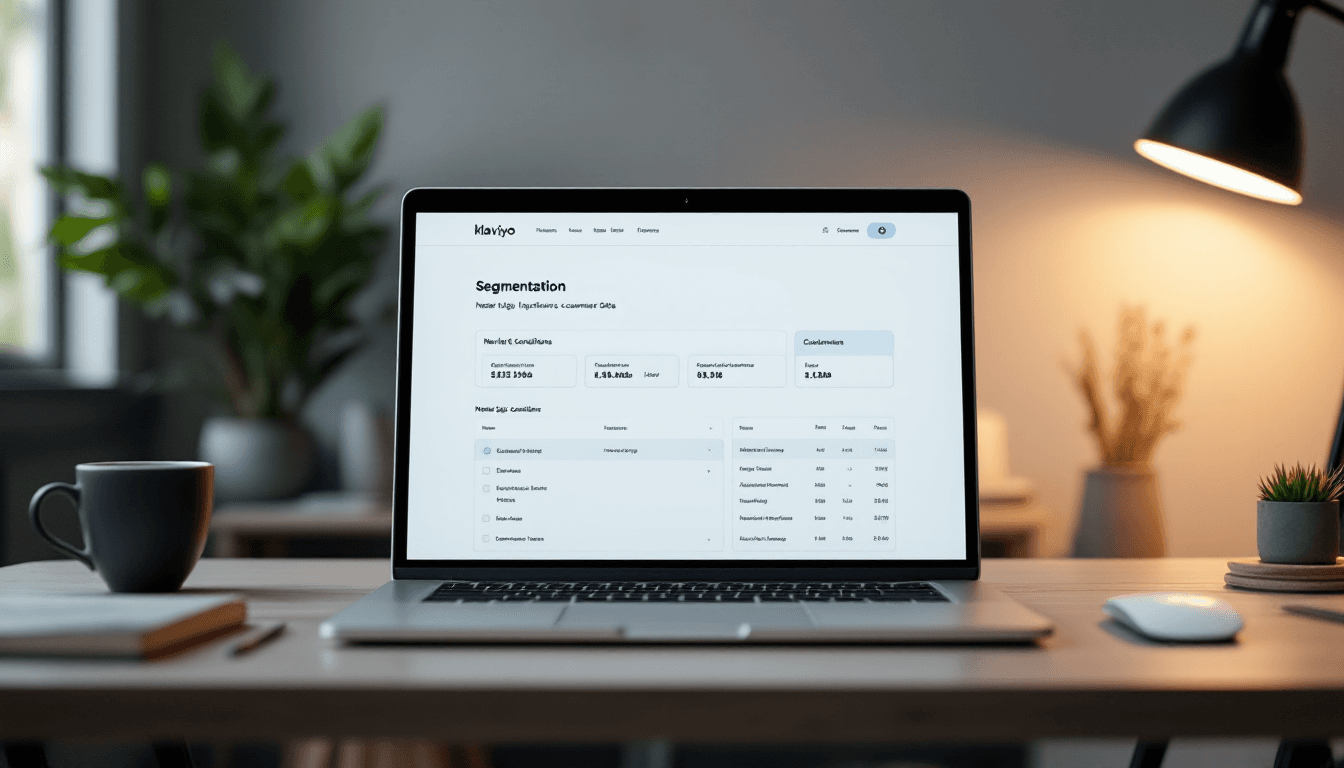
Use one main marketing list, then build everything in segments. Klaviyo's data model treats lists as static opt-in groups (newsletter, SMS, VIP). Segments are dynamic queries that update in real time as customer data changes. You want one master "Newsletter" list for opt-in tracking, then build segments off it.
The five foundational segments every DTC brand needs:
-
Engaged (last 30 days) — Opened or clicked any email in the last 30 days. This is your daily-send audience. Sending to engaged subscribers is the single biggest lever for deliverability.
-
At-risk (no engagement 30-60 days) — Receives a lower send frequency and a re-engagement push.
-
Lapsed (no engagement 60+ days) — Either feeds into a winback flow or gets suppressed entirely. Sending to lapsed subscribers kills your sender reputation.
-
Customers vs prospects — Different messaging, different offers, different cadence. Customers buying their first product vs returning customers are also different cohorts.
-
High-value (top 20% by predictive LTV) — Your VIP audience. Earlier access, exclusive offers, no discount pressure.
Beyond these five, build segments around product affinity (purchased Category X), purchase recency (last 30/60/90 days), and behavioral signals (viewed product 3+ times without buying). Don't build more than 15-20 segments at first — they multiply quickly and become unmanageable.
Common mistake: Maintaining a "VIP" list manually. Manual lists go stale within weeks. Build VIPs as a dynamic segment based on lifetime spend or predicted LTV so the audience updates itself.
Step 3: Essential Flows
Flows are where Klaviyo actually makes you money. The five core flows below generate 25-35% of total store revenue when properly built — often more than your campaign program.
Welcome series (3-5 emails over 7 days).
Trigger: subscriber joins your newsletter list. This is your highest-converting flow — typical 8-15% revenue per recipient.
- Email 1 (immediate): Welcome, brand story, your promise to the subscriber. Include the promised discount if one was used to capture the subscriber.
- Email 2 (day 2): Best-seller showcase or category guide. Tie products to outcomes, not features.
- Email 3 (day 4): Social proof. Customer reviews, UGC, founder quote about why customers love you.
- Email 4 (day 6): Urgency or expiration push if a discount was offered. Otherwise, education content.
- Email 5 (day 7-10, optional): Cross-sell or category exploration.
Abandoned cart (2-3 emails + SMS over 48 hours).
Trigger: checkout started, not completed. Recovers 5-12% of abandoned revenue when built right.
- Email 1 (1 hour): Reminder, cart contents, single CTA back to checkout. No discount yet.
- SMS (4 hours, opted-in only): Short message with cart link. SMS abandoned cart converts 2-3x higher than email alone.
- Email 2 (24 hours): Value reinforcement — reviews of the abandoned products, shipping speed, return policy.
- Email 3 (48 hours, optional): Incentive (10% off or free shipping). Use sparingly — most brands trigger too quickly and train shoppers to abandon for the discount.
Browse abandonment (2 emails over 24 hours).
Trigger: viewed product 2+ times in 7 days, did not add to cart. Captures higher-funnel intent.
- Email 1 (4 hours): Show the viewed product, related items, social proof.
- Email 2 (24 hours): Educational angle — "5 things to consider before buying [category]."
Post-purchase (3-5 emails over 30 days).
Trigger: order placed. The most under-built flow in most accounts. Drives repeat purchase rate and review collection.
- Email 1 (immediate): Order confirmation enhancement — what to expect next, how to use the product.
- Email 2 (day 3): Setup or usage tips. Beauty brands: how to apply. Supplement brands: optimal dosing. Apparel: care instructions.
- Email 3 (day 7-10): Review request. Send AFTER product would have been received and used.
- Email 4 (day 14-21): Cross-sell or replenishment intro.
- Email 5 (day 30): VIP invitation, loyalty signup, or referral request.
Winback (2-3 emails over 14 days).
Trigger: previous customer, no purchase in 90 days (consumables) or 180 days (apparel/durables). Recovers lapsed buyers at a fraction of CAC.
- Email 1: "We miss you" — reminder of what they bought, what's new since.
- Email 2 (7 days): Stronger incentive — free shipping, a meaningful discount, or new product launch.
- Email 3 (14 days, optional): Final touch — "Last chance" with sunset language.
Common mistake: Treating flows as set-and-forget. Review flow performance monthly. Variant-test subject lines, image-vs-text-heavy designs, CTA placement. A 10% lift on welcome flow revenue compounds across every new subscriber for years.
Step 4: Campaign Strategy
Campaigns are the manual sends (newsletters, product drops, promotions). They generate 30-50% of email revenue in well-run accounts. Build a framework, not ad-hoc sends.
Send cadence. Most DTC brands under-send. The right baseline for an engaged list is 2-3 sends per week to your Engaged segment, 1 per week to the broader list. Brands sending one email per month leave the majority of email revenue on the table; brands sending daily to everyone kill deliverability.
Segment first, then send. Never send a campaign to "all subscribers" without thinking about the engagement segment. The same content sent to your Engaged segment vs your full list will see 3-5x higher open rates and zero spam complaint risk to engaged audiences.
Calendar planning. Build a monthly content calendar with three buckets: brand storytelling (35%), product/category education (35%), promotional (30%). Brands that swing to 80% promotional content see open rates collapse within 60-90 days.
Subject line testing. Klaviyo lets you A/B test subject lines on 20-50% of recipients before sending to the rest. Use it on every campaign. The difference between top and bottom quartile subject lines is typically 30-50% open rate.
Send-time optimization. Use Klaviyo's Smart Send Time feature — it learns each subscriber's optimal send time individually. Worth ~10-15% open rate lift vs picking one global send time.
Common mistake: Sending the same campaign to your full list every time. Audience fatigue compounds. Build a "control" segment (small holdout of your most engaged) that gets every send, and rotate your wider audience based on engagement scoring.
Step 5: Deliverability
Deliverability is the silent killer of every Klaviyo account. You can build perfect flows and write perfect copy — but if your emails are landing in the Promotions tab or Spam folder, none of it matters. This is where most brands quietly bleed 20-50% of email revenue.
The four signals inbox providers actually watch:
-
Engagement rate — opens and clicks in the last 30 days. Below 15% engagement, providers start filtering more aggressively. Above 35%, your sends land in the primary inbox.
-
Spam complaint rate — recipients hitting "Report Spam." Anything above 0.1% (1 complaint per 1,000 sends) starts hurting reputation; above 0.3% triggers active throttling.
-
Bounce rate — emails that fail delivery. Hard bounces (invalid address) above 2% suggest poor list hygiene; soft bounces (full mailbox, server issue) above 5% suggest deliverability problems.
-
Sender authentication — SPF, DKIM, DMARC all aligned and passing. Without all three, you're getting filtered.
The deliverability discipline:
- Never email lapsed subscribers. Suppress anyone with no engagement in 90+ days. Yes, even if they "might come back." The damage to sender reputation from sending to dead addresses is worse than any revenue you'd recover.
- Warm slowly. New domains or new senders should ramp from 500 sends/day to 50,000+ over 30 days. Klaviyo handles this if you tell it the sending IP is new.
- Build a sunset flow. 2-3 emails over 30 days to re-engage subscribers who've gone quiet, then auto-suppress non-responders.
- Monitor weekly. Klaviyo's "Deliverability" dashboard shows complaint rate, bounce rate, engagement trend. Check it every Monday.
Common mistake: Buying or scraping email lists. Even one bad list import can permanently damage sender reputation. Klaviyo's terms prohibit it; some brands do it anyway and end up rebuilding from scratch six months later.
What good looks like (90 days after launch)
A properly built Klaviyo account, 90 days post-launch, should show:
- Email + SMS revenue: 25-35% of total store revenue (climbing to 35-45% by month 6)
- Welcome flow conversion: 8-15% per recipient
- Abandoned cart recovery: 5-12% of abandoned revenue recovered
- Account-wide open rate: 35-45% on engaged segments
- Click rate: 2-5% on engaged segments
- Spam complaint rate: under 0.05% on every send
- Bounce rate: under 1.5%
If you're seeing numbers materially below these after 90 days, something in the foundation is broken — usually deliverability authentication or segmentation hygiene.
Related Reads
- How Often Should You Email Your List?
- Email Marketing ROI: The Numbers That Actually Matter
- What Percentage of Revenue Should Come From Email?
- Klaviyo Deliverability Guide
- The 7 Revenue Leaks We Find in Almost Every Klaviyo Account
- eCommerce Glossary: Klaviyo, Flows, Segmentation, Deliverability
Next Steps
Ready to get your Klaviyo setup right? Get a free Klaviyo audit — we'll review your current setup, flag where revenue is leaking, and show you exactly what to fix first. No commitment, delivered within 48 hours.
And if you'd rather hand the whole build to a specialist, our guide to choosing a Klaviyo agency breaks down who's best for what — pricing, strengths, and the questions to ask before you sign.

Written by Mark Cijo
Founder of GOSH Digital. Klaviyo Gold Partner. Helping eCommerce brands grow revenue through data-driven marketing.
Book a free strategy call →