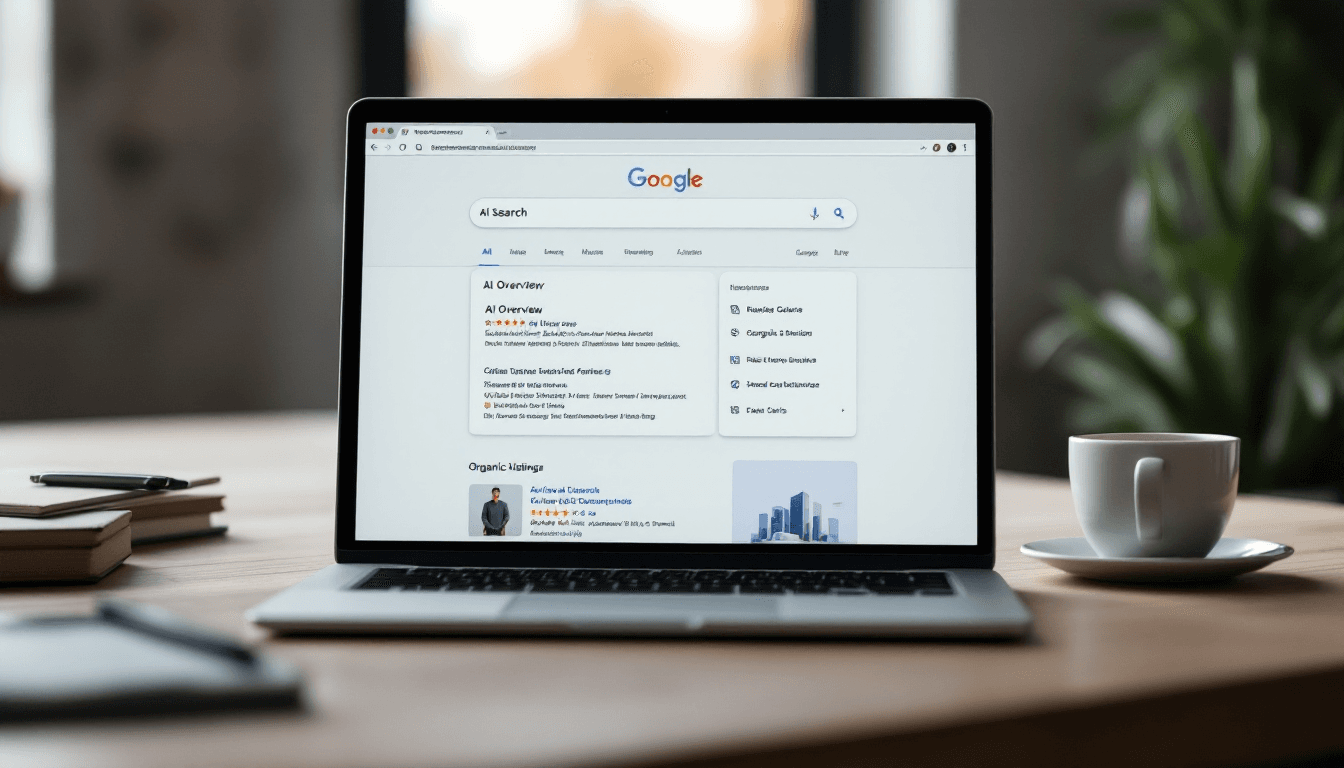
AI Search Optimization 2026: How to Get Cited by ChatGPT
AI search sends fewer visitors than Google — but they arrive ready to buy. The exact structure that gets you cited by ChatGPT, Perplexity, and AI Overviews.

Mark Cijo
Founder, GOSH Digital

The 30-second answer
AI search is a real acquisition channel now — small in volume, unusually high in intent. When we added AI-referrer detection to our own analytics, ChatGPT, Perplexity, and Claude referrals came to just under 1% of sessions — and one of them became a signed client within weeks. Princeton-led research (KDD 2024) found citation-focused structure lifts generative-engine visibility by up to 40%. Sites that structure for AI citation capture the channel. Sites that don't hand it to competitors who do.
The six properties that make content citeable:
- Declarative sentences — LLMs extract clear claims, skip hedges
- Entity mentions — name specific brands, tools, people, places
- Structured data — Article, FAQPage, HowTo, Organization schema
- Source citations — reference authoritative external sources
- Freshness signals — dated content beats undated evergreen
- Answer-first structure — TL;DR blocks, direct answer paragraphs near the top
Here's the uncomfortable part. Your best guide might already rank on page one of Google and still never appear in a ChatGPT answer. The extraction logic is different, and content written for SERPs routinely fails it.
Fix the structure and the same article starts showing up in AI citations within weeks — in front of buyers who've already narrowed their shortlist. The bridge between those two states isn't more content. It's the six properties above, applied deliberately.
Below: how AI search engines actually work under the hood, the exact structural changes that lift citation rates, what breaks citation, and how to measure it.
What Generative Engine Optimization actually is
Generative Engine Optimization (GEO) is the practice of structuring content so it gets cited by AI search engines — not just ranked, cited.
Traditional SEO optimizes for ranking on a search engine results page (SERP). A user types a query, Google returns 10 blue links, you want to be one of them.
GEO optimizes for a different endpoint: being one of the 3-5 sources an LLM quotes when answering a user query. The user types the same question into ChatGPT, Perplexity, or Google AI Overview, gets a synthesized answer, and the answer includes citation links back to the sources the LLM used.
The two channels overlap. Both reward quality content, structured data, and topical authority. But the tactics diverge.
Traditional SEO rewards:
- Keyword optimization
- Backlink authority
- Page-level metadata
- Long-form comprehensiveness
GEO rewards:
- Declarative claim-making
- Entity-rich text
- Extractable answer blocks
- Structured data at scale
A site that only does traditional SEO does moderately well on AI search by default. But deliberate GEO structure moves the needle further: the original GEO research from Princeton (KDD 2024) measured visibility improvements of up to 40% in generative engine responses from citation-focused restructuring alone — no new content, just structure.
How AI search engines actually work
Understanding the citation process helps make sense of what to optimize for. Simplified pipeline for how ChatGPT search, Perplexity, and Google AI Overviews work:
Step 1: User asks a question. "What's a good Klaviyo abandoned cart flow structure?"
Step 2: The AI engine performs a search. It runs a version of the query through its search index (ChatGPT search draws on Bing plus OpenAI's own OAI-SearchBot crawling, Perplexity runs its own crawler, Google AI Overviews use Google Search).
Step 3: The engine retrieves candidate sources. Typically 5-20 URLs that seem relevant to the query.
Step 4: The engine extracts declarative statements from each source. This is the key step — the LLM scans the sources for statements it can attribute confidently. Structured data (schema markup) tells it what content type each page is; declarative sentences are the statements it prioritizes for extraction.
Step 5: The engine synthesizes an answer. It combines extracted statements from 3-5 sources, adds transition language, and generates the answer with citation links back to sources.
Step 6: The user clicks a citation (or doesn't). Citation clicks are the AI-search traffic you're trying to capture.
Optimizing for GEO means optimizing for Step 4 — making your content the easiest source for the LLM to extract citeable statements from.
The 6 properties that lift citation rates
1. Declarative sentences
LLMs preferentially extract sentences that make clear claims. Compare:
Weak (rarely cited): "There are many factors to consider when structuring a Klaviyo abandoned cart flow, and it can depend on your industry and customer base."
Strong (frequently cited): "Klaviyo abandoned cart flows should fire first email at 1 hour, discount at 48 hours, final urgency at 72 hours. Fashion recovers 8-12% of carts; food and beverage 5-8%."
The strong version makes specific, extractable claims. The weak version hedges.
Every FAQ answer, TL;DR bullet, and mid-body claim in your content should be tightened toward the strong pattern. Reduce hedges. Add specific numbers. Make claims that can be quoted.
2. Entity mentions
Content that names specific brands, tools, people, and places gets cited more than abstract content. Compare:
Weak: "Choose an email marketing platform that fits your business needs."
Strong: "Choose Klaviyo for Shopify DTC stores under $10M ARR, Braze for enterprise, Mailchimp for content publishers, MoEngage for headless commerce stacks."
The strong version is instantly citeable because it makes entity-specific claims. LLMs love this because they can attribute the recommendation to your source with confidence.
Practical fix: audit your content for generic references and replace them with named entities where accurate.
3. Structured data (Schema.org markup)
Structured data tells LLMs what your content IS. This dramatically improves citation accuracy because the LLM doesn't have to infer content type from text.
Five schema types matter most:
- Article schema — every blog post. Include headline, author, datePublished, dateModified, publisher.
- FAQPage schema — every post with FAQ sections. Highest-lift addition for AI Overview citation.
- HowTo schema — step-by-step guides.
- Organization schema — homepage. Establishes brand entity identity.
- LocalBusiness schema — for brands with physical locations.
Beyond these, entity-linking schema (Wikidata identifiers, sameAs relationships) helps LLMs cross-reference your brand with known entities.
Schema won't rescue thin content. But on pages that already answer real questions, it's one of the highest-leverage single additions — the engine no longer has to guess whether your page is a citeable source. The full vocabulary lives at schema.org; start with FAQPage and Article.
4. Source citations
LLMs reward content that itself cites credible sources. When your content links out to authoritative references (regulatory bodies, primary research, established industry sources), LLMs interpret this as a signal that YOUR content is more trustworthy.
Practical: link to the actual regulatory documents when discussing compliance (DPDP.gov.in for DPDP, ico.org.uk for GDPR guidance). Link to primary research when quoting benchmarks. Link to authoritative industry sources when discussing platform behavior (Klaviyo's own documentation, Shopify's developer docs, Meta's business help center).
This isn't about backlinks going out (SEO). It's about signaling trustworthiness (GEO).
5. Freshness signals
Dated content beats undated evergreen content on any query where recency matters. LLMs increasingly weight recency as a citation factor — a piece frozen in 2024 loses citations to a current-year piece covering the same ground, even when the older one is more thorough.
Practical fixes:
- Include the year in your title where relevant ("2026 Klaviyo Flow Benchmarks" > "Klaviyo Flow Benchmarks")
- Populate
dateModifiedwhen you update content - Reference current-year context in the article body
- Update evergreen articles annually and update the modification date
6. Answer-first structure
Position direct answers near the top of the page. TL;DR blocks, executive summary paragraphs, and answer-first structure get pulled into citation windows more often than answers buried in the middle of long articles.
Structure pattern that works consistently:
# Article title
## The 30-second answer
[Direct, declarative answer with 3-5 bulleted key points]
---
[Long-form article body follows]
The LLM scans the top of your article first. If it finds a citation-ready block, it stops there. If it has to scroll through 1,000 words of intro before finding the actual answer, it moves to the next source.
What breaks AI citation
Six patterns to avoid:
Extensive hedging. "It might be worth considering...", "You may want to think about...", "Sometimes it can help to..." — these produce sentences LLMs don't extract because the claim isn't firm.
Marketing fluff without factual anchors. "Unlock your brand's true potential", "Discover the secret to email marketing success" — filtered out as low-quality content.
Missing structured data. The LLM has to infer content type from text, reducing citation accuracy.
Login walls and paywalls. Content behind auth isn't crawled at all — AI search engines can't cite what they can't read.
Excessive first-person voice without third-person verifiable claims. "I think you should..." doesn't get cited because the LLM can't attribute the statement to a verifiable source.
Contradictions and hallucinated specifics. LLMs increasingly weight source trustworthiness. Content that contradicts itself or invents specific numbers (that don't match other sources) gets filtered out.
How to measure AI search traffic
Two setup requirements:
1. GA4 custom channel grouping for AI search referrers.
Create a custom channel in GA4 → Configure → Channel groupings that detects:
chatgpt.com,openai.com— ChatGPT searchperplexity.ai— Perplexityclaude.ai,anthropic.com— Claudebing.com/copilot— Bing Copilotgoogle.comwithsearch-appearanceparameter — Google AI Overview
Some AI engines strip referrer headers on outbound clicks. For those, use UTM parameters where you can add them (share content on ChatGPT with utm_source=chatgpt) and infer the rest via direct-traffic spike analysis timed to when your content gets cited.
2. Custom dimension for AI-search channel.
In our admin dashboard we tag every chatgpt.com, perplexity.ai, and claude.ai referrer as ai-search and report it separately from general organic. This alone reveals the channel most brands are ignoring — before we added it, our own AI-search traffic looked like generic direct traffic in Google Analytics.
The GEO audit checklist
Run through this on your existing content:
Structure:
- TL;DR block at the top of every article
- FAQ section with 5-8 substantive questions on every article
- Direct answers in first 200 words
Content:
- Declarative sentences with specific numbers and named entities
- No excessive hedging
- External source citations to authoritative references
- Year in titles where recency matters
-
dateModifiedpopulated in schema when content is updated
Schema.org markup:
- Article schema on every blog post
- FAQPage schema on every post with FAQs
- HowTo schema on step-by-step guides
- Organization schema on homepage
- Wikidata identifiers in
sameAsfor entity linking
Measurement:
- GA4 custom channel grouping for AI-search referrers
- Custom dimension separating AI-search from general organic
- Weekly review of AI-search traffic + citation-worthy content
Miss any of these and you're leaving AI-search traffic on the table.
The realistic timeline
AI search engines index and re-crawl aggressively, so the feedback loop is shorter than classic SEO. A realistic planning timeline:
- Weeks 1-2: Structural changes (TL;DR, FAQ restructure, schema) get re-crawled and become extractable
- Weeks 3-4: Individual pieces of content start appearing in AI-search citations
- Months 2-3: Measurable AI-search traffic to individual URLs
- Month 6+: Competing with established authorities in high-intent AI-citation spaces
Faster than traditional SEO — but not overnight. LLMs need to see your content structured correctly across multiple pages before they consistently pick you as a citation source. Ours took about a month from shipping the structure to the first attributable ChatGPT referral that mattered.
What NOT to do
Don't stuff schema markup with keywords. Schema is for content type, not keyword optimization. Google penalizes schema abuse.
Don't add fake authorship or entity signals. LLMs increasingly verify against known entities. Made-up author credentials get flagged and hurt trust.
Don't publish AI-generated content without humanization. LLMs recognize AI-generated text patterns and DE-prioritize sources that produce them. If you use AI to draft, humanize thoroughly before publishing — otherwise the citation rate on that content approaches zero.
Don't over-optimize for a single AI engine. ChatGPT, Perplexity, Claude, Google AI Overview all use different retrieval logic. Optimize for the six universal principles (declarative, entity-rich, structured, cited, fresh, answer-first) rather than trying to game a specific engine.
Don't ignore traditional SEO. GEO layers on top of SEO. Google's own documentation on AI features is explicit: there are no additional requirements to appear in AI Overviews — standard SEO best practices apply. If your baseline is broken (bad site speed, missing metadata, no backlinks), no amount of GEO optimization saves you. Fix the fundamentals first.
Where to go from here
If you want the GEO audit run on your site — book a free strategy call and we'll map the specific structural changes that lift your AI-search citation rate.
If you want the technical implementation done — work with a Klaviyo Gold Partner agency that built its own AI-referrer attribution and works with 150+ ecommerce brands.
For deeper technical Klaviyo content that layers on the GEO foundation, see our complete Klaviyo guide for 2026.
Related reading
- The Complete Klaviyo Guide for 2026 — the retention playbook
- iOS 27 Meta Attribution Prep — the paid measurement layer
- Klaviyo Composer 2026 Review — AI in your email workflow
- DPDP Klaviyo Compliance Checklist — India compliance
- 2026 Klaviyo Flow Revenue Benchmarks — what "good" looks like

Written by Mark Cijo
Founder of GOSH Digital. Klaviyo Gold Partner. Helping eCommerce brands grow revenue through data-driven marketing.
Book a free strategy call →