Klaviyo AI in 2026: What to Turn On (and What to Skip)
An honest field review of Klaviyo AI in 2026 — Composer, SMS AI, predictive analytics, and send-time tools. What drives revenue and what wastes your time, from 150+ account audits.

Mark Cijo
Founder, GOSH Digital
Klaviyo ships AI features faster than most brands can test them. Composer. Customer Agent. SMS AI. Segments AI. Personalized Send Time. Open your dashboard and half the buttons have a sparkle icon on them now.
Here's the problem. Some of these features genuinely print money. Others eat hours of setup time and give you back generic output you could've written faster yourself. And Klaviyo's marketing won't tell you which is which — every feature page reads like it's the second coming.
Turn on the wrong ones and you're editing bland AI copy at 11 PM. Ignore the right ones and you're leaving open-rate points and repeat purchases on the table while your competitors quietly collect them.
We manage Klaviyo accounts for eCommerce brands across the US, UK, EU, Middle East, and India, and we've tested every one of these features on real revenue. This is the honest scorecard.
The 30-second answer
Klaviyo's AI is strongest where it does math and weakest where it does creativity. The prediction and timing features are worth turning on today; the generative features are worth using as drafting tools with a human editor on top.
- Turn on now: predictive analytics (CLV, churn risk, next order date) and send-time optimization
- Use with editing: Composer and Email AI for campaign first drafts and subject line variants
- Use with verification: Segments AI for plain-English segment building
- Watch closely: Customer Agent for support-plus-selling conversations
- Keep human: brand voice, campaign strategy, and anything compliance-sensitive
The 2026 Klaviyo AI map
The feature set has grown a lot since the early "subject line suggestions" days. As of mid-2026, Klaviyo's AI suite spans Composer (goal-to-campaign generation), Customer Agent (24/7 support conversations that can also sell), Email AI and SMS AI (content drafting per channel), Segments AI (plain-language segment building), Reviews AI, Image Remix, Product Recommendations, Channel Affinity, and the predictive stack — Predicted CLV, Churn Risk, and Personalized Send Time.
That's a dozen features. You don't need all of them. Here's what each one earns in practice.
Turn on today: predictive analytics
This is still the crown jewel, same as when we first reviewed it — and it's gotten better as the models retrain weekly on your account data.
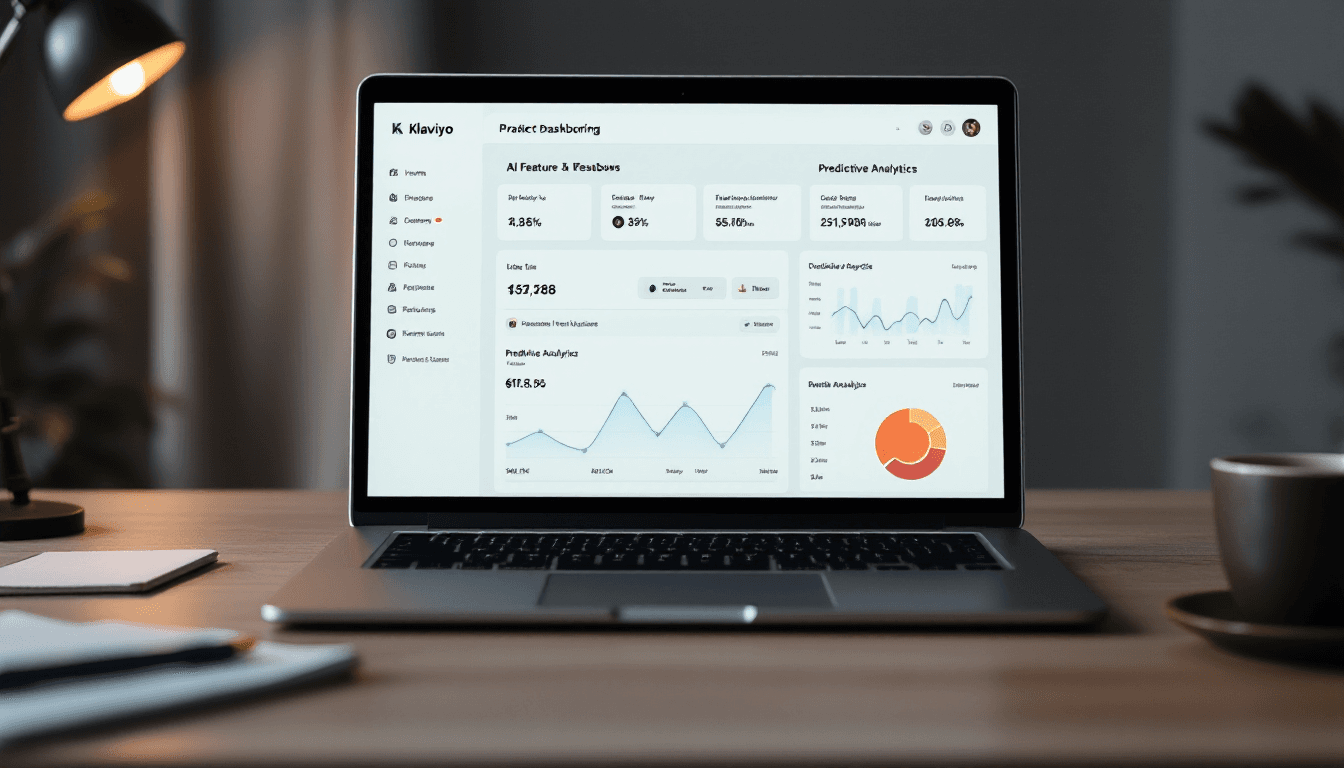
Klaviyo calculates forward-looking metrics on every customer profile: historic CLV, predicted CLV for the next year, total CLV, churn risk, average time between orders, and predicted next order date. Per Klaviyo's predictive analytics documentation, the section appears once your account clears four thresholds: at least 500 customers who've placed a real order (not cancelled, not refunded, not zero-value), an eCommerce integration or API-fed order events, at least 180 days of order history with orders in the last 30 days, and at least some customers with three or more orders.
Why it works: the model learns from actual purchase patterns across your whole customer base and applies them to individuals. Customers who buy product X reorder on a knowable cadence. Discount-only buyers show lower lifetime value. The math finds this. You never would, not manually, not across ten thousand profiles.
How we use it on client accounts:
- Segment by predicted CLV. Top 20% gets VIP treatment — early access, better offers, personal outreach.
- Segment by churn risk. High-risk customers get a retention campaign before they ghost, not after.
- Trigger replenishment flows off predicted next order date. A reminder 5-7 days before their expected reorder feels like service, not marketing.
- Allocate spend by CLV. Retain and upsell the high-value profiles. Stop overpaying to acquire low-value lookalikes.
We wrote a full implementation walkthrough in our Klaviyo predictive analytics guide.
Verdict: use it. If your account doesn't qualify yet, that's a data problem, not a plan problem — and it fixes itself as you grow.
Turn on today: send-time optimization
Timing is the cheapest lift in email. No new creative, no new strategy. Same email, better moment.
Klaviyo now has two distinct tools here, and people mix them up constantly.
Smart Send Time finds one optimal window for a whole audience. Per Klaviyo's Smart Send Time documentation, it runs an exploratory send spread across 24 hours, watches when engagement clusters, then runs focused sends inside a two-hour window around the winner. It's email-only and needs 12,000+ recipients per test — so it's a tool for established lists, not week-one stores.
Personalized Send Time is the newer, sharper instrument. Instead of one window for everyone, it schedules each recipient at their own predicted best moment inside a delivery window you set, using reinforcement learning trained on opens, clicks, and orders. Klaviyo's documentation confirms it works across email, SMS, push, and WhatsApp campaigns (not flows yet), requires scheduling at least a day in advance, and sits behind a Marketing Analytics or Advanced Klaviyo Data Platform subscription. It even holds out control groups automatically so you can see the actual lift instead of taking Klaviyo's word for it.
Across our client accounts, timing optimization has produced open rate gains of 3-7 percentage points and click gains of 1-3 points. Small numbers per send. Compounding numbers per quarter.
One warning: never use either tool for time-boxed promotions. A flash sale ending at midnight can't have its emails spread across 24 hours. Manual timing for urgency, AI timing for everything else.
Verdict: use it — Smart Send Time if you're testing on a big list, Personalized Send Time if your plan includes it.
Worth testing: Composer and Email AI
This is the section that changed most since our original 2025 review. Back then, Klaviyo's generative email content was the weakest thing in the product — bland copy, corporate-friendly tone, edit time that matched write-from-scratch time.
Composer moved the bar. Tell it what you're trying to achieve and it uncovers the opportunity, builds the audience, drafts the content, and plans the send. For a brand shipping four campaigns a week, going from blank canvas to editable draft in under a minute buys back real hours on your calendar — it doesn't buy you a voice.
Because the voice problem hasn't gone away. Composer's output reads competent and generic. It doesn't know about last week's restock chaos, your founder's speaking style, or why your list responds to self-deprecating subject lines. The brands getting value treat it as a first-draft machine with a mandatory human edit. We published a full breakdown — including the exact three-part prompt structure that produces usable drafts — in our Klaviyo Composer review.
Subject line scoring deserves its own note: use it as a gut check, not gospel. A low score on a weird, brand-specific subject line often means the model hasn't seen your niche, not that the line is bad. Test it anyway.
Verdict: use for drafts and variants. Never ship unedited.
Worth testing: SMS AI
SMS AI drafts text campaigns and suggests replies to incoming messages. It's useful for the same reason Composer is — speed on routine sends — and limited for the same reason too.
SMS punishes generic copy harder than email does. You get maybe 160 characters of someone's most personal inbox. An AI draft gets you structure and compliance-safe phrasing fast; the personality still has to come from you. And anything touching consent or quiet hours needs a human check, full stop — TCPA fines don't care that a model wrote the message.
Verdict: draft with it, edit ruthlessly, keep a human on compliance.
Worth testing: Segments AI
Describe your audience in plain English — "customers who bought skincare twice but haven't ordered in 90 days" — and Segments AI builds the segment definition. For newer marketers this removes a genuine skill barrier. For experienced operators it's a speed tool.
Two habits keep it honest. First, always open the generated segment and read the actual conditions — plain-language input can produce subtly wrong logic (AND where you meant OR, engagement windows you didn't ask for). Second, sanity-check the segment size before sending. If you know your repeat-buyer base and the segment comes back triple that, something's off.
Segmentation strategy itself — which segments deserve to exist — is still your job. Our Klaviyo segmentation guide covers the framework we use.
Verdict: useful accelerant. Verify the logic every time.
Watch closely: Customer Agent
Customer Agent answers customer questions around the clock and spots selling opportunities inside those conversations. It's the most ambitious thing in the suite — and the one with the widest gap between demo and deployment.
Done well, it deflects the "where's my order" tickets and turns sizing questions into conversions while you sleep. Done lazily, it's a chatbot wearing your brand's name and inventing return policies. The difference is setup: product data quality, policy documentation, and clear escalation rules for when a human takes over.
We went deep on this one separately in our Composer and Customer Agent analysis.
Verdict: pilot it on support-heavy stores with clean product data. Don't set-and-forget.
Still needs a human: strategy and voice
Here's the through-line after years of testing these features across brands: Klaviyo's AI is excellent at pattern math and mediocre at meaning.
It can't know that you're deliberately not discounting this quarter to protect margin. It can't know your co-founder just did a podcast that's about to spike branded search. It can't weigh inventory, margin, and brand positioning when it suggests featuring your bestseller for the fourth week running. Campaign calendars, positioning, brand voice, and anything where the wrong words carry legal or reputational cost — that's human work, and it's staying human work.
The winning setup isn't AI versus marketer. It's machine precision on timing, targeting, and prediction, with human judgment on what to say and why. The brands making the most money from Klaviyo in 2026 run exactly that split. For the full-stack picture of how these features fit into flows, campaigns, and reporting, start with our complete Klaviyo guide for 2026.
The scorecard
Turn on today:
- Predictive analytics (CLV, churn risk, next order date)
- Smart Send Time / Personalized Send Time
Use with a human editor:
- Composer and Email AI (first drafts, subject line variants)
- SMS AI (drafts only; human owns compliance)
- Segments AI (verify the logic)
Pilot carefully:
- Customer Agent (support-heavy stores, clean data, escalation rules)
Keep fully human:
- Campaign strategy and calendar
- Brand voice and launch copy
- Compliance-sensitive messaging
FAQ: Klaviyo AI in 2026
Which Klaviyo AI features actually drive revenue? Predictive analytics and send-time optimization, in that order. Segments built on predicted CLV and churn risk move repeat purchase revenue; timing tools lift engagement on everything you already send. The generative features save time rather than directly making money.
What data does predictive analytics require? Per Klaviyo's documentation: 500+ customers with real placed orders, an eCommerce integration or API order events, 180+ days of order history with orders in the last 30 days, and some customers with three or more orders.
Smart Send Time vs Personalized Send Time? Smart Send Time finds one best window for a whole audience via 24-hour exploratory tests (email-only, 12,000+ recipients needed). Personalized Send Time delivers to each recipient at their own predicted moment across email, SMS, push, and WhatsApp — but requires a Marketing Analytics or Advanced KDP subscription and day-ahead scheduling.
Should AI write my campaigns? Draft, yes. Ship, no. Roughly 60-80% of routine campaigns can start from a Composer draft with human editing; launches, apologies, and compliance-heavy sends get written by a person.
Does any of this need a plan upgrade? Only Personalized Send Time has a hard subscription gate. Everything else is gated by data volume, not plan tier.
What if my brand is too small? Skip the prediction features until you clear the data thresholds. Use Segments AI, Email AI, and Composer now — and build the welcome, cart, and browse flows that generate the data the rest of the suite needs.
Sources & References
- Klaviyo AI — official product hub — Klaviyo
- Understanding Klaviyo's predictive analytics — Klaviyo Help Center
- Understanding Smart Send Time in Klaviyo — Klaviyo Help Center
- Drive performance with right time delivery using Personalized Send Time — Klaviyo Help Center
Related Reads
- Klaviyo Rebuilt Itself Around AI Agents: What to Turn On Before BFCM
- Klaviyo Composer 2026: When AI Beats Manual
- The Complete Klaviyo Guide for 2026
- Email Marketing for Supplement Brands
- Welcome Sequence Template: The First 5 Emails
The Bottom Line
Klaviyo's best AI features are the ones that give you better data for better decisions — prediction and timing. Its weakest are still the ones that try to replace your judgment and your voice, even though Composer has narrowed that gap considerably since 2025.
Turn on the math. Edit the words. Test everything before you trust it.
Want us to audit your Klaviyo account and configure the AI features that actually drive revenue — and switch off the ones burning your time? Book a free strategy call and we'll show you exactly what to enable, disable, and improve.

Written by Mark Cijo
Founder of GOSH Digital. Klaviyo Gold Partner. Helping eCommerce brands grow revenue through data-driven marketing.
Book a free strategy call →