How to Increase Repeat Purchase Rate on Shopify (By Purchase Cycle)
Increase repeat purchase rate on Shopify. Calculate time between orders, trigger the second purchase by cycle, turn one-time buyers into repeat customers.

Mark Cijo
Founder, GOSH Digital
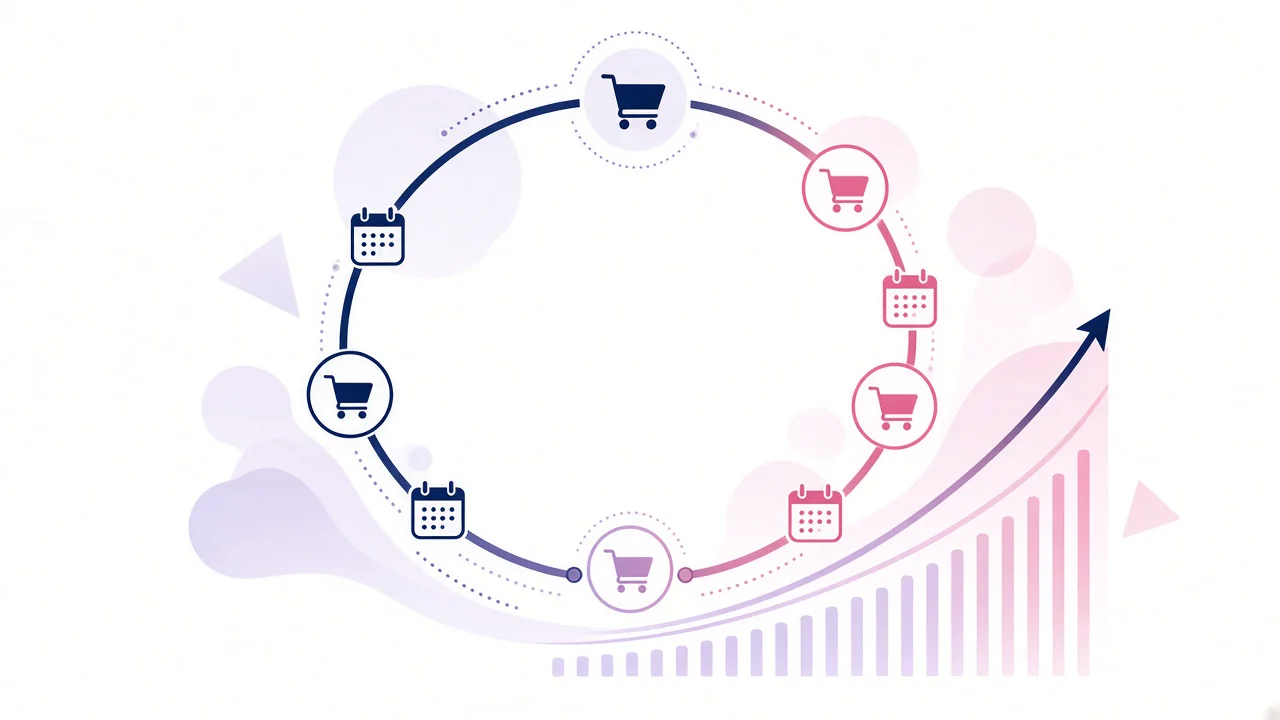
Here's how to increase repeat purchase rate for eCommerce: figure out when your customers naturally reorder, reach them just before that moment, and make it stupid easy to buy again.
Most Shopify stores focus on getting the first sale and then forget the customer exists until the next campaign. The result: missed repeat purchase opportunities and lower lifetime value.
The fix isn't complicated. It's timing. You calculate your product's average time between orders, trigger communication at the right moment, and build systems that bring people back on their natural purchase cycle.
This isn't about blasting discount codes. It's about understanding purchase cycles and matching your strategy to them.
Let me show you how.
Last reviewed: 25 October 2026. Klaviyo benchmarks sourced from Klaviyo's 2026 abandoned cart benchmark report and Klaviyo's deliverability guidance.
What Is Repeat Purchase Rate and Why It Matters
Repeat purchase rate is the percentage of your customers who come back and buy again.
Formula: (Number of customers who made 2+ purchases / Total number of customers) x 100
Most people calculate this over a 12-month window. If you had 1,000 customers in the past year and 270 of them bought more than once, your repeat purchase rate is 27%.
Why this matters more than new customer acquisition: According to research by Bain & Company, increasing retention rates by just 5% increases profits by 25-95% (source). In our experience, customer acquisition costs keep getting more expensive across paid channels, making retention economics more favorable.
If your acquisition channels dry up tomorrow (Meta raises costs, Google changes the algorithm, your best influencer partnership ends), a strong repeat purchase rate is what keeps revenue flowing.
What Is a Good Repeat Purchase Rate for a Shopify Store?
Product category matters enormously when evaluating repeat purchase rate.
Consumable products (supplements, coffee, pet food, skincare) naturally achieve higher repeat rates because customers need to restock regularly. Timing-based replenishment systems work especially well for these categories.
Fashion and lifestyle brands typically see different patterns because the purchase cycle is driven by seasonal needs and style preferences rather than product depletion.
Home goods and furniture see lower rates because customers don't replace these items frequently, and repeat purchases often mean buying different items in the category rather than restocking the same product.
The key insight: your repeat purchase rate depends more on your product's natural purchase cycle than on any universal benchmark. A furniture brand may be performing excellently for its category at a rate that would be poor for a supplement brand.
The number that matters more: Is it trending up or down? Track it monthly and compare to the previous period and the same period last year to account for seasonality.
How to Calculate Your Product's Time Between Orders
You can't increase repeat purchase rate until you know when customers naturally reorder. This is the single most overlooked piece of retention strategy.
Method 1: Pull Shopify Customer Data
Go to Shopify Admin → Analytics → Reports → Customers by cohort (or export customer order data). Look for customers who placed 2+ orders and calculate the median time between their first and second order. Use median instead of average to ignore outliers.
Method 2: Calculate From Product Usage
If you don't have enough repeat purchase data yet (new store, new product line), estimate based on product consumption.
Supplements: Servings per container / daily servings = days of supply
Skincare: Product volume (oz) / average daily usage (oz) = days of supply
Coffee: Bag weight (oz) / (cups per day x grams per cup) = days of supply
Pet food: Bag weight / (pet weight x daily feeding rate) = days of supply
For a 60-capsule supplement bottle taken twice daily, that's 30 days of supply. For a 12 oz bag of coffee beans (assuming 2 cups/day at 15g per cup), that's roughly 20 days.
Send your replenishment reminder 7-10 days before the expected reorder date. You want to catch them before they run out, not after they've already gone to the competitor or decided to skip a cycle.
Method 3: Segment by Purchase Cycle in Klaviyo
If you're using Klaviyo (which you should be if you care about retention), you can pull this data directly.
Go to Profiles, then create a segment of customers who have "Placed Order at least 2 times." Export that segment with order dates, then calculate the time delta between consecutive orders.
Klaviyo's predictive analytics also estimate the "Expected Date of Next Order" for individual profiles once you have enough historical data. Use that to personalize timing at the individual level instead of relying on category averages.
If you're not sure what your time between orders looks like or where to start with retention, let's talk through your repeat-purchase numbers on a strategy call. Book here.
The 3 Purchase Cycle Strategies
Not all products reorder the same way. You need a different strategy depending on whether your product is consumable, seasonal, or one-off.
Strategy 1: Timing-Based Replenishment (Consumables)
Applies to: Supplements, coffee, pet food, skincare, cleaning supplies, candles, protein powder, anything that gets used up.
The approach: Trigger a repurchase reminder based on days since last order. This is the highest-ROI retention strategy for consumable products.
Build a replenishment flow in Klaviyo that:
- Triggers X days after the first order (where X = expected time between orders minus 7-10 days)
- Sends a series of 2-3 emails reminding them to reorder
- Includes a direct "Reorder" link to the exact product they bought
- Optionally pitches a subscription to automate future orders
Why this works: You're reaching the customer at the exact moment they're thinking about reordering anyway. There's no cold outreach. You're not interrupting them. You're providing a service (a reminder plus an easy way to act on it).
Well-executed replenishment flows can become a meaningful revenue channel for consumable brands. This is not a "nice to have." It's a systematic revenue driver.
Strategy 2: Event-Driven Campaigns (Seasonal Products)
Applies to: Holiday decor, seasonal apparel, back-to-school supplies, gift items, anything with a calendar-driven purchase occasion.
The approach: Trigger campaigns around the calendar event, not around individual purchase timing. You're not reminding someone to reorder Christmas lights in May. You're reminding them in October that they bought lights from you last year and here's this year's new collection.
Build cohort-based campaigns that target:
- "Bought winter apparel last year" → send the winter 2026 collection in September
- "Bought Valentine's gifts last year" → send the Valentine's 2027 collection in January
- "Bought back-to-school supplies last year" → send the 2027 back-to-school campaign in July
The key: Segment by what they bought last year during that season, not by generic "purchased in the last 12 months." The more specific the match between what they bought and what you're offering now, the higher the conversion rate.
You can layer in early-bird discounts for past buyers ("You bought from us last year, here's first access") to create urgency and reward loyalty.
Strategy 3: Cross-Sell and New Product Notification (One-Off Purchases)
Applies to: Electronics, furniture, big-ticket items, anything where customers won't repurchase the same item.
The approach: Since they won't buy the same product again, you need adjacent products, accessories, upgrades, or entirely new categories.
Build post-purchase flows that:
- Educate them on the product they just bought (how to use it, care tips, warranty info)
- Introduce complementary products or accessories mid-flow
- Add them to a new product launch list so they hear about future drops first
Illustrative example: A customer buys a standing desk. They won't buy another standing desk for years, but they might buy a desk mat, a monitor arm, an ergonomic chair, cable management accessories, or desk lighting within the next 6 months. Your post-purchase series introduces those categories one by one.
The repeat purchase isn't the same item. It's the next item in the ecosystem.
For brands with frequent product launches, the strategy shifts to keeping customers engaged with content and community so they're primed to buy when the next drop happens. This is how streetwear and fashion brands with limited releases maintain high repeat purchase rates despite low product overlap.
The Repeat Purchase Playbook (Step by Step)
Here's the system we build for clients who want to increase repeat purchase rate systematically.
Step 1: Audit Your Current Repeat Purchase Rate
Pull the number from Shopify's customer reports or calculate it manually. If you're below 25% and you sell consumables or frequent-purchase products, you have a massive opportunity.
Also calculate:
- Time between first and second order (median days)
- Time between second and third order (median days)
- Percentage of customers who make a third purchase (this is often where brands lose momentum)
These three numbers tell you where the drop-off happens and which purchase transition to focus on first.
Step 2: Map Purchase Cycles by Product Category
Group your products into timing cohorts:
- Fast cycle (20-40 days): Coffee, daily supplements, pet food
- Medium cycle (40-75 days): Skincare, monthly supplements, household consumables
- Slow cycle (75-120 days): Seasonal apparel, quarterly replenishment items
- Occasional/one-off: Furniture, big-ticket, non-repeatable items
Each cohort needs its own repurchase trigger timing and messaging strategy.
Step 3: Build the Post-Purchase Sequence
Most brands send one post-purchase email (order confirmation) and then nothing until the next campaign. That's the gap.
Build a multi-touch post-purchase flow that spans the repurchase window:
For a 60-day consumable:
- Day 0: Order confirmation
- Day 2: Shipping notification
- Day 7: "How to use [product]" educational email
- Day 20: Usage tips or related content
- Day 45: "Time to restock?" replenishment reminder with direct reorder link
- Day 52: Follow-up with subscription offer
- Day 60: SMS reminder if they haven't reordered
The psychology: The early emails (days 7 and 20) build engagement without selling. The later emails (days 45, 52, 60) are transactional and time-sensitive. By day 45, they've had two positive touchpoints already, so the replenishment reminder feels helpful, not spammy.
Step 4: Introduce Subscriptions as a Convenience Play
Subscriptions drive higher lifetime value than one-time repeat purchases because they lock in the cadence. A subscriber is worth 2-4x a repeat one-time buyer over 12 months.
But don't lead with subscriptions on the first purchase. Customers need to try the product first.
Introduce subscriptions in your replenishment flow around the second or third reorder reminder. Frame it as convenience: "You've reordered [product] twice now. Want it to just show up automatically every 45 days? Subscribe and save 15%."
Step 5: Build a Winback Flow for Lapsed Customers
Not everyone reorders on schedule. Some customers skip a cycle, intend to come back later, and then forget entirely.
Define "lapsed" as 1.5x to 2x your expected repurchase cycle. For a 60-day product, a customer who hasn't ordered in 90-120 days is lapsed.
Trigger a winback flow:
Email 1 (Day 90): "We haven't seen you in a while. Here's what's new."
Email 2 (Day 100): Include a small incentive (10-15% off) to lower the friction of coming back.
Email 3 (Day 110): Last chance offer or "Is there a reason you stopped buying?" feedback ask.
The goal isn't just to recover the sale. It's to understand why they lapsed so you can prevent it for future customers. If 30% of lapsed customers say "I forgot to reorder," that tells you to send your replenishment reminders earlier. If they say "The product didn't work as expected," that's a product or education problem, not a marketing problem.
Tactical Levers to Pull (What Actually Moves the Needle)
Beyond flows and timing, here are the specific tactics that increase repeat purchase rate.
Lever 1: One-Click Reorder Links
Friction kills repeat purchases. If someone has to navigate back to your site, find the product, add it to cart, and check out again, you've lost a percentage of people at each step.
Use Klaviyo's dynamic product blocks to show the exact product they bought with a direct "Reorder Now" link that pre-adds the item to cart. One click, straight to checkout.
For Shopify stores, you can also implement a "Reorder" button in the customer account dashboard that creates a duplicate of a past order with one click.
Impact: In our experience, reducing friction at the repurchase moment improves conversion from replenishment emails compared to generic "Shop Now" links.
Lever 2: SMS for Urgency (Not Volume)
Email is your workhorse for education, nurturing, and storytelling. SMS is your urgency channel for time-sensitive moments.
Use SMS to:
- Send a restock alert the day an out-of-stock item comes back (if they browsed it or bought it before)
- Trigger a replenishment reminder if they didn't open the replenishment email
- Notify them of a flash sale or limited drop (if they're an engaged customer)
Don't treat SMS like email. Klaviyo recommends limiting SMS to 2-6 messages per recipient per month, and monitoring your unsubscribe rate closely (source). High-frequency SMS burns lists fast. Send strategically, not frequently.
Lever 3: Loyalty Programs Tied to Purchase Frequency
Loyalty points tied to dollars spent are fine, but they don't directly incentivize repeat behavior. Points tied to purchase frequency do.
Illustrative structure:
- 1st purchase: Welcome reward (10% off next order)
- 2nd purchase: Bonus points (2x points on this order)
- 3rd purchase: VIP tier unlock (free shipping forever)
- 5th purchase: Exclusive product access or early-bird new launch notification
Each milestone is designed to pull the customer to the next purchase. The reward timing maps to your expected repurchase cycle.
This works especially well for fashion and lifestyle brands where the product itself doesn't have a natural repurchase cycle but the brand does (new drops every 4-6 weeks).
Lever 4: Referral Incentives After the Second Purchase
Don't ask for referrals after the first purchase. You don't know if they're happy yet.
Ask after the second purchase. A customer who bought twice is demonstrating repeat behavior and is statistically more likely to recommend you (source).
Trigger a referral ask in your post-purchase flow after order #2, or in a dedicated campaign targeting customers with 2+ orders.
According to ReferralCandy's research, referred customers are 10.7 times more likely to become successful advocates themselves compared to customers acquired through other channels (source).
Lever 5: Personalized Time Between Orders (Advanced)
Once you have enough data, stop using category-level averages and start personalizing timing at the individual level.
If Customer A reorders every 28 days and Customer B reorders every 52 days, they should get different replenishment timing.
Klaviyo's predictive analytics calculate "Expected Date of Next Order" based on individual behavior. Use that to dynamically adjust your flow timing.
This requires:
- At least 6-12 months of data
- Enough repeat customers to train the model
- A Klaviyo account with predictive analytics enabled (available on higher-tier plans)
Personalized timing typically improves replenishment flow conversion rates compared to category-level timing because it matches each customer's actual behavior rather than an average.
Common Mistakes That Kill Repeat Purchase Rate
Mistake 1: Sending Replenishment Reminders Too Late
If your customer already ran out of product and either went without or bought from a competitor, your reminder is useless. Send the reminder before they run out, not after.
Err on the side of early. If your product lasts 60 days, send the reminder on day 48, not day 65.
Mistake 2: Treating All Customers the Same
A customer who bought once should not get the same messaging as a customer who bought five times. Segment your retention efforts by purchase count:
- 1 purchase: Focus on education and engagement to prime the second purchase
- 2-3 purchases: Introduce subscriptions and loyalty rewards
- 4+ purchases: VIP treatment, early access, exclusive offers
The messaging, offer, and urgency level should escalate as purchase count increases.
Mistake 3: Over-Discounting
If every replenishment email includes a 20% discount, you've trained customers to wait for the discount. They'll stop buying at full price.
Use discounts strategically: first-time acquisition discount, winback discount for lapsed customers, and loyalty milestone rewards. For regular replenishment reminders, lead with convenience and timing, not price.
Mistake 4: Ignoring Deliverability
All the flows and timing in the world don't matter if your emails land in spam.
Check your email deliverability metrics monthly:
- Open rate (if it dropped 20%+, you have a deliverability problem)
- Spam complaint rate (Klaviyo recommends below 0.01%; Gmail requires below 0.1% and never reaching 0.3% per Gmail's sender guidelines)
- Unsubscribe rate (keep below 0.3% per campaign per Klaviyo's guidance)
- Bounce rate (monitor hard bounces closely and suppress them immediately)
Set up SPF, DKIM, and DMARC records. Use a branded sending domain. Build a sunset flow to suppress unengaged subscribers. These are table stakes.
Mistake 5: Not Measuring Time Between Orders
If you're only tracking repeat purchase rate as a percentage, you're missing the leading indicator.
Time between orders tells you if your retention efforts are working before the percentage shifts. If your average time between orders is shrinking (customers are coming back faster), your repeat purchase rate will rise in the next 60-90 days. If it's growing (customers are taking longer to come back), your repeat rate is about to drop.
Track it monthly. Klaviyo's Cohort Analysis report shows this by purchase count (time between 1st and 2nd order, 2nd and 3rd, etc.).
How Much Can You Realistically Improve Repeat Purchase Rate?
The improvement timeline depends on your starting point, your product category, and your current purchase cycle length.
What to expect in the first 90 days: You'll see initial movement as customers who were already close to their natural reorder window receive better-timed reminders and have friction removed from the repurchase process. Brands with broken or missing replenishment flows often see the fastest early gains because there's low-hanging fruit to capture.
What to expect after 90-180 days: The compounding effect builds as more first-time buyers enter their second and third purchase windows with proper nurturing already in place. This is when systematic improvements to education, engagement, and timing start showing up in overall repeat purchase rate.
Brands starting below their category average often see larger absolute improvements because basic infrastructure (replenishment timing, friction reduction, deliverability fixes) wasn't in place. Brands already performing well are optimizing on the margins, which produces smaller percentage gains but still meaningful revenue impact.
When to Prioritize Repeat Purchase Rate Over Acquisition
Here's when retention becomes more valuable than new customer acquisition:
- Your CAC (customer acquisition cost) is rising. If Meta CPMs doubled or Google CPC is up 40%, acquiring new customers at your old margins is impossible. Retention is cheaper.
- Your LTV:CAC ratio is below 3:1. If you're spending $50 to acquire a customer worth $120, you're barely profitable. Increasing repeat purchase rate increases LTV without touching CAC.
- You're hitting diminishing returns on acquisition channels. If you've maxed out your best audiences and incremental spend isn't scaling linearly, shift budget to retention.
- You sell consumables or repeat-purchase products. If your product naturally reorders, retention deserves strategic investment, not just leftover budget after acquisition spending.
The right allocation between acquisition and retention spending depends on your stage, margin structure, and growth goals. Early-stage brands typically focus more heavily on building the customer base. More mature brands with established customer cohorts can shift more resources toward maximizing lifetime value.
Strategy Call: Repeat Purchase Analysis
If you're not sure where your repeat purchase rate stands or how your time between orders compares to your product category, let's talk through your repeat-purchase numbers on a strategy call.
As a Klaviyo Gold Partner, at GOSH Digital, we work with 150+ active clients, $70M+ revenue driven, and $23M+ ad spend managed.
Related Reads
- Replenishment Flows: The Set-It-and-Forget-It Revenue Machine
- The 5 Retention Metrics Every eCommerce Store Should Track
- Why Is My Klaviyo Revenue Down? Step-by-Step Diagnostic
- Ecommerce Retention Marketing Services: Turn One-Time Buyers Into Repeat Customers
Mark Cijo is the founder of GOSH Digital, a Klaviyo Gold Partner agency based in Dubai. He's built retention and replenishment systems for 150+ eCommerce brands and believes the second purchase is where the margin lives.

Written by Mark Cijo
Founder of GOSH Digital. Klaviyo Gold Partner. Helping eCommerce brands grow revenue through data-driven marketing.
Book a free strategy call →