The Win-Back Flow That Saves 15% of Churning Customers
Most win-back flows are glorified discount blasts. Here's the exact Klaviyo win-back sequence we use to recover 15% of lapsed customers for 150+ brands.

Mark Cijo
Founder, GOSH Digital
Here's a number most eCommerce brands ignore: it costs 5-7x more to acquire a new customer than to keep an existing one. And yet, when we audit Klaviyo accounts at GOSH Digital, the win-back flow is either nonexistent, turned off, or a single sad email with "We miss you" and a 10% coupon.
That's not a win-back flow. That's a Hail Mary.
A real win-back flow is a structured sequence designed to re-engage customers before they're completely gone. Done right, it saves 12-18% of churning customers. Done wrong -- or not done at all -- you're watching revenue walk out the door every single day.
We've built win-back flows for 150+ eCommerce brands. Here's what actually works.
When Does a Customer Actually "Churn"?
Before you build anything, you need to define what "lapsed" means for your store. This isn't a universal number -- it depends on your product category and purchase cycle.
| Product Type | Average Repurchase Cycle | Win-Back Trigger Point |
|---|---|---|
| Consumables (supplements, coffee, skincare) | 30-45 days | 60 days since last purchase |
| Fashion / Apparel | 60-90 days | 120 days since last purchase |
| Home goods / Furniture | 120-180 days | 240 days since last purchase |
| Electronics / Tech | 180-365 days | 365 days since last purchase |
The trigger point should be roughly 1.5-2x your average repurchase cycle. If you sell protein powder that lasts 30 days, someone who hasn't bought in 60 days is drifting. Someone who hasn't bought in 90 days is probably gone.
How to find your number in Klaviyo: Go to Analytics, then Metrics, then Placed Order. Look at the time between orders for your top customers. That's your baseline repurchase cycle. Multiply by 1.5-2x, and that's your win-back trigger.
Why Most Win-Back Flows Fail
We've audited hundreds of win-back flows. The same mistakes show up over and over.
Mistake 1: Starting Too Late
If your repurchase cycle is 45 days and your win-back flow doesn't trigger until 180 days, you've already lost them. By the time that email lands, they've forgotten your brand exists. The win-back window is narrow -- start too late and no discount on earth will bring them back.
Mistake 2: Leading With a Discount
"We miss you! Here's 20% off." Cool. You just trained your entire customer base that if they stop buying, they get a discount. This creates a perverse incentive loop where your best customers learn to wait for the win-back coupon.
Your first email should never lead with a discount. Lead with value, lead with what's new, lead with a reason to come back. Save the discount for email 3 or 4 -- after you've exhausted non-discount angles.
Mistake 3: Only Sending One Email
One email is not a flow. It's a shot in the dark. We see this constantly -- brands set up a single win-back email, see a 2% conversion rate, and conclude that "win-back emails don't work for our brand."
No. Your one email didn't work. A multi-touch sequence with escalating urgency works for almost every brand.
Mistake 4: Ignoring SMS
If someone isn't opening your emails, sending more emails isn't the answer. SMS cuts through. We consistently see win-back SMS messages with 25-35% click-through rates -- even for customers who haven't opened an email in months.
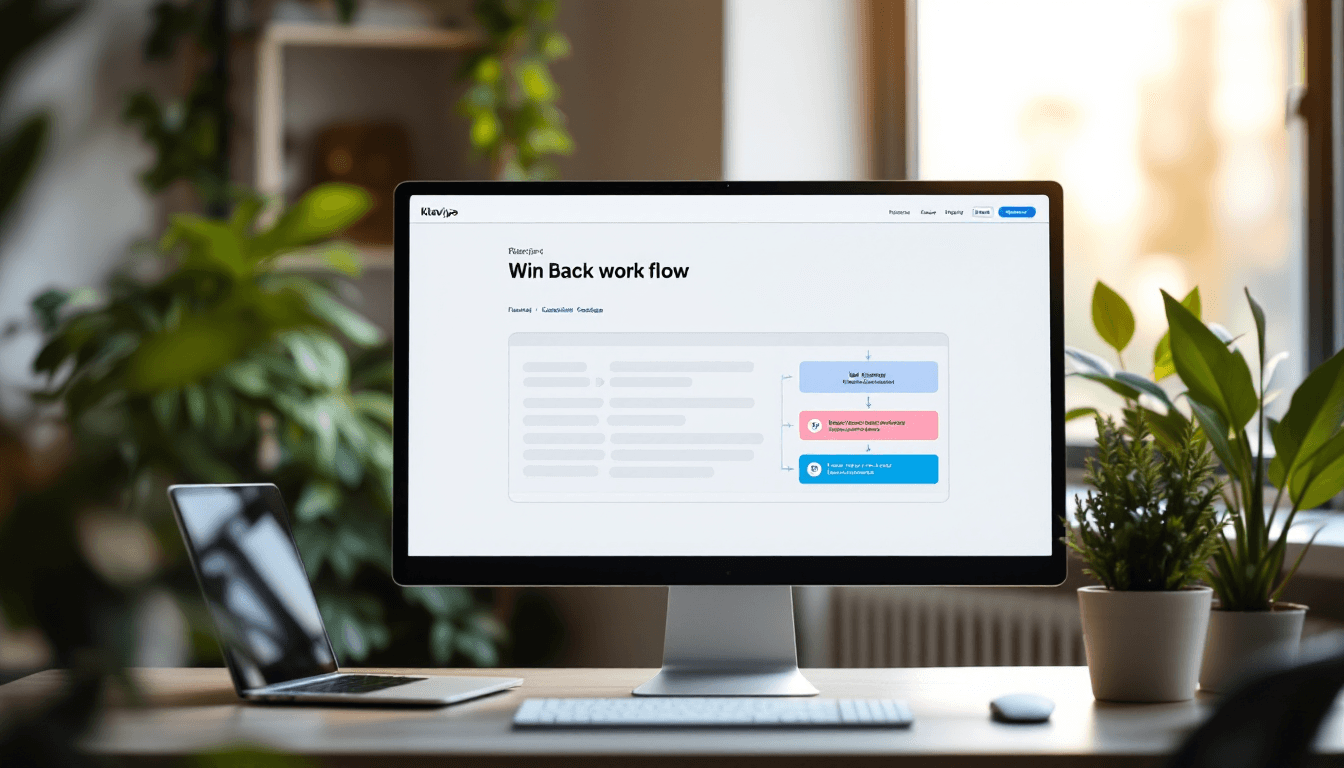
The Exact Win-Back Flow: 5 Emails + 2 SMS
Here's the complete sequence we build for our clients. Five emails, two SMS messages, with conditional logic.
Before You Start: The Segment
Create a Klaviyo segment for your win-back trigger:
Conditions:
- Has placed an order at least once (all time)
- Has NOT placed an order in the last [X] days (your trigger point from the table above)
- Has NOT been in this flow in the last 90 days (prevents re-entry too soon)
Use this segment as the flow trigger. In Klaviyo, go to Flows, then Create Flow, then choose "Create from Scratch." Set the trigger to "Segment" and pick your win-back segment.
Email 1: The Check-In (Day 0 of Flow Entry)
Subject line: "It's been a while, [first_name]" or "Still there?"
Content:
- Acknowledge the time gap -- don't pretend it's a normal email
- Highlight what's new (new products, new collections, improvements)
- Show 2-3 bestselling or trending products
- One CTA: "See What's New"
- No discount. Not yet.
Why this works: People lapse for different reasons. Some forgot about you. Some had a bad experience. Some just got busy. This email addresses the "forgot about you" crowd, which is the largest group. Showing what's new gives them a reason to re-engage without devaluing your brand.
SMS 1: The Nudge (Day 1)
Message: "Hey [first_name], it's been a minute! We've got some new drops you might like. Take a look: [link]"
Keep it under 160 characters. Casual, friendly, not salesy.
Email 2: Social Proof (Day 3)
Subject line: "Here's what people are loving right now" or "Our customers can't stop buying this"
Content:
- 3-5 product blocks showing your most-reviewed or most-purchased items
- Include star ratings and review snippets
- Real customer photos if you have them (UGC works great here)
- CTA: "Shop Bestsellers"
- Still no discount.
Why social proof: When someone's been away for a while, they need reassurance that they're making a good decision by coming back. Seeing that other people love your products rebuilds trust and FOMO simultaneously.
Email 3: The "We Want You Back" Offer (Day 7)
Subject line: "A little something for you, [first_name]" or "This one's on us"
Content:
- Now you bring in the incentive -- but frame it as a gift, not a bribe
- Offer depends on your margins: 15% off, free shipping, or a free sample/gift with purchase
- Use a dynamic coupon code (not a static code that gets shared on coupon sites)
- Include product recommendations based on their past purchases
- CTA: "Claim Your [Offer]"
- Add urgency: "Valid for 7 days"
The discount escalation matters. By waiting until email 3, you've already captured the customers who just needed a reminder (emails 1-2). The discount only goes to people who need an extra push. This saves you money and protects your margins.
Email 4: Urgency + Last Chance (Day 10)
Subject line: "Last chance: your [offer] expires soon" or "Your 15% off is about to disappear"
Content:
- Reminder that the offer from Email 3 is expiring
- Countdown language (not a literal countdown timer -- those are tacky in emails and often break)
- Show the specific products they previously bought or browsed
- CTA: "Use Your [Offer] Before It's Gone"
SMS 2: Final Push (Day 12)
Message: "Last call, [first_name]. Your [15% off / free shipping] expires tomorrow. Don't miss out: [link]"
Email 5: The Breakup Email (Day 14)
Subject line: "Should we stop emailing you?" or "Is this goodbye?"
Content:
- This is the most important email in the entire flow
- Be honest: "We've noticed you haven't shopped with us in a while. If you're no longer interested, that's okay -- but we want to make sure we're not cluttering your inbox."
- Give them two options: "I want to keep hearing from you" (button) or "Unsubscribe" (link)
- Optional: Include one final, slightly higher incentive (20% off, free gift)
- This email does two things: it triggers loss aversion in people who DO still want to hear from you, and it cleans your list of people who don't
Why the breakup email works: We consistently see 8-12% of breakup email recipients click the "keep me" button. That's 8-12% of people who were about to be lost forever, re-engaged in one email. The psychology is simple: people don't like being broken up with, even by a brand.
Conditional Splits That 10x Your Results
The basic 5-email sequence above is solid. But the magic is in the conditional logic.
Split 1: VIP vs. Standard Customers
Before Email 3 (the discount email), add a conditional split:
- VIP customers (top 20% by lifetime value): Higher incentive (20% off or free gift), warmer copy ("You're one of our favorite customers"), VIP-exclusive product recommendations
- Standard customers: Regular incentive (10-15% off or free shipping)
Your best customers deserve better treatment. And the math works: a 20% discount to a customer with $800 LTV is a far better investment than the same discount to someone who bought once for $30.
Split 2: Engagement Level
After Email 2, add a split based on email engagement:
- Opened at least one of the first two emails: Continue the standard flow
- Didn't open either email: Skip straight to SMS + the discount email (they're clearly not reading your emails, so try a different channel and a stronger hook)
Split 3: Purchase History
Personalize product recommendations based on what they actually bought:
- Bought skincare: Show new skincare arrivals
- Bought supplements: Show restocking reminders
- Bought apparel: Show new collection drops
Klaviyo makes this easy with conditional content blocks. You don't need separate flows -- just dynamic blocks within the same emails that change based on purchase history.
Benchmarks: Is Your Win-Back Flow Working?
Here's what we see across 150+ accounts:
| Metric | Poor | Average | Good | Excellent |
|---|---|---|---|---|
| Win-back rate (full flow) | Under 5% | 5-10% | 10-15% | 15%+ |
| Revenue per recipient | Under $0.80 | $0.80-$2.00 | $2.00-$4.00 | $4.00+ |
| Open rate (Email 1) | Under 20% | 20-30% | 30-40% | 40%+ |
| Breakup email re-engagement | Under 3% | 3-6% | 6-10% | 10%+ |
| SMS click rate | Under 5% | 5-15% | 15-25% | 25%+ |
If your win-back rate is below 10%, there's significant room for optimization. If it's above 15%, you're in the top tier.
The Math: What a Win-Back Flow Is Worth
Let's run the numbers for a mid-size Shopify store.
Say you have 5,000 customers who've lapsed in the last year. Your average order value is $75. Without a win-back flow, those customers are just... gone.
Without a win-back flow: $0 recovered. 5,000 customers lost.
With a basic 1-email win-back (5% recovery rate): 5,000 x 5% x $75 = $18,750
With our full 5-email + SMS flow (15% recovery rate): 5,000 x 15% x $75 = $56,250
That's $56,250 in revenue from customers you were going to lose anyway. And the flow runs automatically once you set it up. It works while you sleep, while you're on vacation, while you're focused on other things.
Over a year, with new customers cycling into the lapsed segment every month, a well-built win-back flow easily generates $100K+ for a mid-size store.
The Setup Checklist
Before you go live with your win-back flow:
- Defined your repurchase cycle and win-back trigger point
- Created a segment with the right conditions (purchased before, no recent purchase, hasn't been in flow recently)
- Email 1 focuses on what's new -- no discount
- Email 2 uses social proof and bestsellers
- Email 3 introduces a discount with a dynamic coupon code and expiration
- Email 4 creates urgency around the expiring offer
- Email 5 is a breakup email with re-engagement or unsubscribe options
- SMS messages are added for non-openers and as a final push
- Conditional splits separate VIPs from standard customers
- Product recommendations are personalized to past purchase categories
- Smart Sending is set to 16 hours
- Flow filter prevents re-entry within 90 days
- All emails tested on mobile
Don't Just Win Them Back -- Keep Them
One more thing. If your win-back flow re-engages a customer and they make a purchase, you need to immediately loop them into your post-purchase flow and regular campaign cadence. Don't let them drift again.
Set up a flow filter so that anyone who places an order exits the win-back flow and enters your post-purchase sequence. The worst thing you can do is win someone back and then go silent.
Related Reads
- Back in Stock Alerts: The Flow You're Probably Missing
- The Welcome Flow That Turns Subscribers Into Buyers
- Klaviyo Segmentation: Beyond the Basics
Get Your Flows Audited for Free
We'll pull up your Klaviyo account, evaluate your win-back flow (or build one from scratch if you don't have one), and show you the revenue you're leaving on the table. No pitch, no pressure -- just the numbers.
Mark Cijo is the founder of GOSH Digital, a Klaviyo Gold Partner agency that's driven $70M+ in revenue for 150+ eCommerce brands. He spends most of his time inside Klaviyo accounts, finding the money brands didn't know they were leaving behind.

Written by Mark Cijo
Founder of GOSH Digital. Klaviyo Gold Partner. Helping eCommerce brands grow revenue through data-driven marketing.
Book a free strategy call →