Tobi Lütke's AI Memo Hit One Year Ago. Meta, Microsoft
In March 2025, Shopify's CEO told employees they must prove AI can't do the work before hiring. The memo went viral.

Mark Cijo
Founder, GOSH Digital
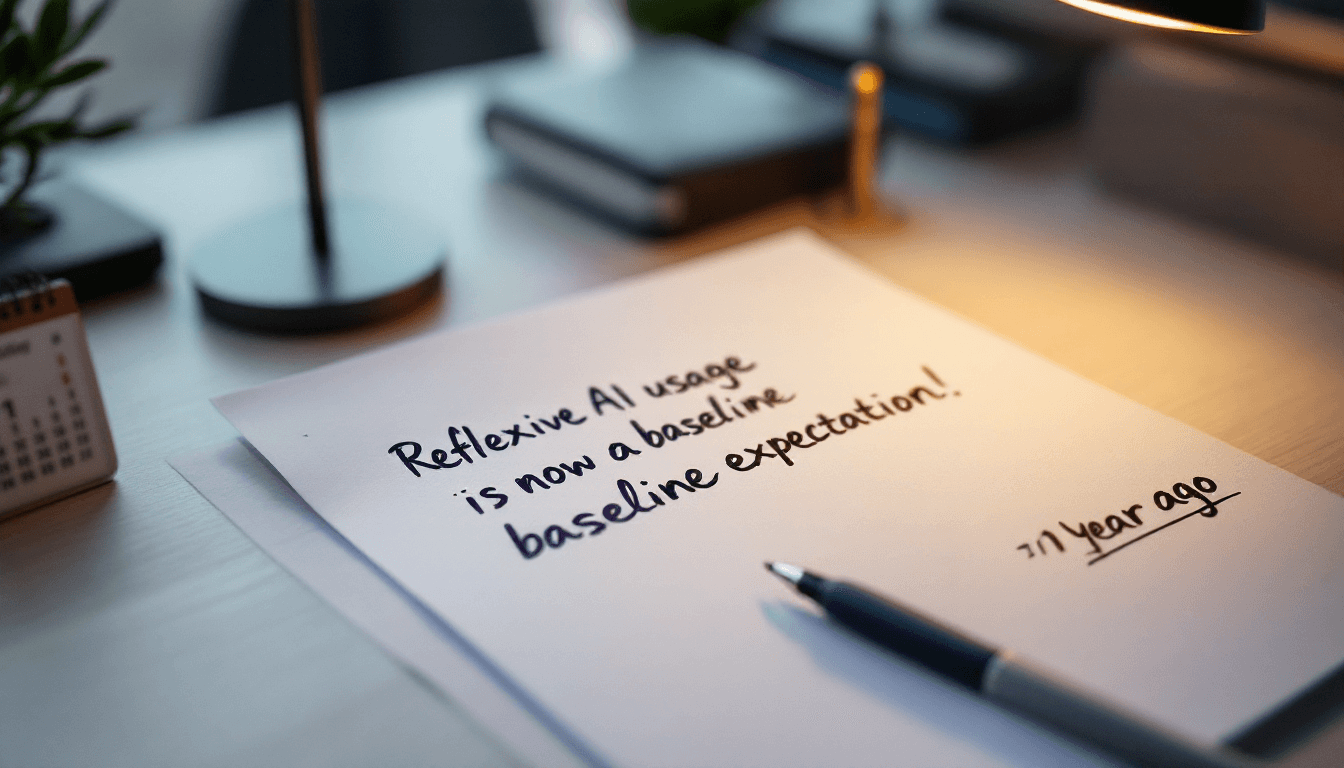
One year ago, Tobi Lütke sent a memo to all of Shopify's employees that ended up being one of the most-quoted leadership documents of the decade.
The headline: "Reflexive AI usage is now a baseline expectation at Shopify." The kicker: teams asking for more headcount or resources had to demonstrate the work couldn't be done with AI first.
The internet lost its mind. Some called it visionary. Others called it dystopian. Twelve months later, the take that mattered is the one nobody was making at the time: this memo was always less about hiring and more about positioning the entire company — and by extension, every Shopify merchant — to thrive in the AI commerce era.
Meta, Microsoft, Google, and Nvidia have all since adopted some version of the same policy. The "prove AI can't do it" filter is now the operating model of the most aggressive tech companies on earth.
Here's what that means for your Shopify store specifically, and why most merchants are reading the wrong lesson.
What the memo actually said
The full memo had six concrete points:
- Everyone at Shopify is expected to use AI
- All projects must use AI during the prototyping phase
- AI use is included in performance and peer reviews
- Everyone must share what they learned using AI
- Teams must first check if something can be done with AI before requesting headcount
- "Everyone" includes the executive team and Lütke himself
Read it carefully. The memo isn't "we're replacing humans with AI." The memo is "we're raising the bar on what a human at Shopify is for."
In practice: Shopify employees aren't being fired. The bar for what they work on is being raised. Routine work gets AI. Human time goes to the strategic 20% that actually compounds. That's the actual play.
The wrong lesson for Shopify merchants
The wrong lesson — and the one I see most merchants pulling from this memo — is: "I should use AI to replace my marketing team / customer service team / store operations team."
That's the lesson Klarna learned the hard way when they replaced 700 customer service agents with AI, watched their CSAT crater, and had to rehire humans within 18 months. Replacing humans with AI for the work humans are still better at is not the play. The play is using AI to clear the routine 80% so your humans can do the strategic 20% that actually grows the business.
For a Shopify merchant, here's what that looks like in practice.
What it actually means for your Shopify store
1. Sidekick Pulse is the merchant version of the memo
Shopify built Sidekick Pulse — the proactive AI advisor that surfaces opportunities in your store data — as the operational embodiment of the memo. The premise: a Shopify merchant in 2026 shouldn't be doing routine analysis. Sidekick should be doing it, surfacing findings, and the merchant should be deciding what to act on.
Brands using Sidekick Pulse daily are quietly outperforming brands that haven't turned it on. The difference is hours per week. The merchant who reviews Sidekick's daily briefing for 15 minutes and acts on the highest-leverage finding is operating at a different speed than the merchant who spends 4 hours a week pulling reports manually and never gets around to the analysis.
The memo's call-to-action for Shopify employees applies directly to you: prove AI can't do this part of your job before you keep doing it manually.
2. AI should be doing your email program's routine work — not your strategy
Same logic. Klaviyo Composer generates campaigns from a prompt. Customer Agent handles Tier 1 support tickets in email and WhatsApp. Personalised send time at the individual subscriber level is now live.
The routine 80% of your email program — flow building, send time optimisation, basic segmentation, FAQ responses — should be handled by AI in 2026. Your strategist or agency should be focused on the 20%: the BFCM strategy, the brand voice, the multi-step launch campaign, the deliverability monitoring, the CSAT-sensitive escalations.
If your in-house team or agency is spending 60% of their time on the work AI can now do — that's the gap. We help clients restructure for this through our email and SMS services, and the productivity improvement is substantial.
3. Customer service tiers — the same model
Tier 1 (FAQ, order status, returns): AI handles fully. Tier 2 (refunds, complex orders): AI drafts, human reviews. Tier 3 (distressed customer, brand crisis, legal exposure): humans always. We laid out the full framework in our Klarna piece. The merchants who get this tiering right save real money AND improve CSAT. The merchants who push AI into Tier 3 to save more money destroy customer trust.
4. Product copy, ad creative, image variants — AI generation, human review
For most Shopify brands in 2026, AI should be generating: product descriptions, ad creative variants, image edits, A/B test variants, blog post drafts, social media captions. A human should be reviewing for brand voice, accuracy, and edge cases.
Brands trying to "outsource creative thinking to AI" get generic output that performs worse than the human-written version it replaced. Brands using AI to generate 20 variants of a hook, then human-selecting the 3 that match the brand voice, get 3-5x the testing throughput their team had before.
5. The headcount question for your business
The Tobi memo's "prove AI can't do it before hiring" rule applies directly to merchants. Before you hire your next email marketer, content writer, paid media specialist, or customer service rep — ask:
- What percentage of this role's work is AI-able right now?
- Could I get away with a part-time human + AI tooling instead of a full-time hire?
- Is the role actually about the strategic 20%, or have we constructed a role that's mostly the routine 80%?
The brands hiring well in 2026 are hiring strategists, not executors. The brands hiring badly are still hiring executors for work AI will absorb within 12 months.
Same logic applies to agency partnerships. We've restructured how we work with clients over the last 18 months — less time on routine campaign deployment (AI handles it), more time on strategy, attribution analysis, and the BFCM-tier work that compounds. That's why we positioned our Klaviyo Gold Partner agency the way we did: strategic depth, not execution volume.
The viral lesson Tobi never said out loud
The reason this memo went viral is that Tobi accidentally said something everyone in tech leadership was thinking but nobody had been brave enough to write: the human-to-AI work allocation is being radically restructured, and the companies that figure it out first will pull dramatically ahead of the ones that don't.
That applies to Shopify (the company). It applies to Shopify merchants (their customers). It applies to agencies (us). It applies to every brand reading this post.
The brands shipping the restructuring fast are getting more output per dollar than ever in eCommerce history. The brands waiting for "AI to be ready" are watching competitors win on speed, accuracy, and operating margin.
What we'd do this quarter for your store
If you're running a Shopify brand and you haven't audited which parts of your operation could be AI-led — here's the start:
- Map every recurring task your team does — content, email, ads, support, ops
- Tag each one: AI-able / AI-assisted / human-only
- Track time spent on the AI-able category for two weeks
- Identify the 3 biggest "obviously AI-able" tasks and pilot AI on them for 30 days
- Reinvest the freed time in the strategic 20% — BFCM planning, brand voice, attribution analysis, new channel testing
This is the audit we run with clients through our AI automation services — and the ROI is real and fast. Most brands free up 8-15 hours per week within 60 days. That time, redirected into strategic work, is where the next quarter's growth comes from.
Book a strategy call and we'll walk through this audit for your specific operation. The brands that restructure now will be the brands competitors can't catch up to in 18 months.
The honest summary
Tobi Lütke's memo wasn't about firing humans. It was about raising the bar on what humans at Shopify should be doing — and by extension, what merchants should be doing too.
A year later, every major tech company has adopted the same operating principle. The merchants who hold themselves to the same standard will outpace the merchants who don't.
The question isn't "should I use AI?" It's "can I prove AI can't do this part of my job?" If you can't prove it, AI should be doing it. Your time should be on the work that compounds.
Sources:
- Shopify CEO Tobi Lütke tells employees to prove AI can't do the job — BetaKit
- Shopify CEO's bold AI ultimatum — Marketing AI Institute
- Tobi Lütke X memo thread
- Shopify's AI Memo Was a Filter, Not a Productivity Play — Nate's Newsletter
- Shopify CEO: teams must prove AI can't do a task before hiring — Tom's Hardware

Written by Mark Cijo
Founder of GOSH Digital. Klaviyo Gold Partner. Helping eCommerce brands grow revenue through data-driven marketing.
Book a free strategy call →