The Metrics
- 3x return on total ad spend generated from paid media
- $23M+ total ad spend managed across 31 months
- 2.6x average blended ROAS across the full engagement
- 75,000+ orders driven through paid channels
- ~$750 average order value
- 3.97x peak ROAS (November 2022)
- $199.52 lowest CPA achieved
- 25–42% of revenue came through financing (Affirm/Klarna)
Before: $1.1M/Month in Spend and Nobody Knew What Was Working
Let me tell you about the biggest ad account I've ever managed.
I don't say that to brag. I say it because the scale of this thing taught me things about paid media you simply cannot learn at $20K or $50K a month. Some lessons only come when there are seven figures on the table every 30 days.
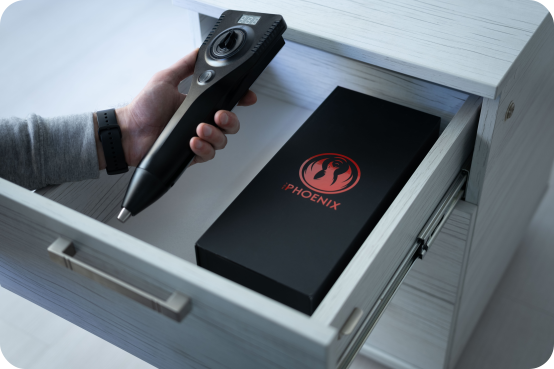
The Phoenix is a health and wellness eCommerce brand. High-ticket products. Roughly $750 average order value. These aren't impulse buys. People research. They compare. They think about it for days, sometimes weeks, before pulling the trigger.
When they came to us in early 2022, they were already spending big. About $1.1 million a month on paid media across Google and Meta. Not a typo. Seven figures. Monthly. On ads.
And here's the thing — it wasn't not working. They were generating revenue. But the ROAS was bouncing all over the place. 3x one month. 1.9x the next. Then 2.3x. Then 2.8x. No consistency. No predictability. Just a roller coaster that happened to cost a million dollars a month to ride.
CPA was equally erratic. Some months they were acquiring customers at $280. Some months it spiked to $450. For a brand spending this kind of money, that variance is terrifying. A $170 swing in CAC across 4,000+ monthly orders? That's the difference between a wildly profitable month and one that makes your CFO lose sleep.
Attribution was the third problem, and it was the worst one.
The brand had Affirm and Klarna financing — smart for a high-AOV product, because not everyone can drop $750 at once. But nobody was factoring financing revenue back into the ad performance data. 25–42% of total revenue was effectively invisible in the ad dashboards. Decisions were being made on incomplete numbers. Imagine flying a plane where a third of the instruments don't work. That's what this was.
The brand didn't need someone to "run ads." They had that. They needed someone who understood paid media strategy at scale to turn this into a machine. Something predictable. Something they could model against. Something that would let them sleep at night knowing the million dollars they were spending this month was going to come back as two and a half million — not maybe, not hopefully, but reliably.
That's where we came in.
After: 3x Return on Ad Spend, 75K+ Orders, and a Playbook for Scaling at Any Budget
Over 31 months — January 2022 through July 2024 — we managed over $23 million in total ad spend for The Phoenix.
That spend generated more than $56 million in revenue. Over 75,000 orders. At an average blended ROAS of 2.6x across the entire engagement.
The headline number doesn't tell the real story. Here are the moments that do:
March 2022 — our third month in. We spent $1.86M and pulled in $3.86M in revenue. Nearly 4,900 orders in a single month. That was the moment I knew this account had a ceiling way higher than anyone thought.
November 2022 — BFCM. This one still gives me chills. We spent $822K and generated $3.26M in revenue. A 3.97x ROAS. CPA dropped to $199.52 — the lowest we ever hit. On a $750 AOV product. We were acquiring customers at roughly a quarter of what they spent on their first purchase. At that math, everything else is gravy.
The managed decline — the part most agencies won't write a case study about, and the part I'm most proud of. When market conditions shifted in 2023 and into 2024, we didn't keep throwing money at it and hoping. We strategically pulled spend from $1.1M/month down to around $600K/month — while holding 2.5x+ ROAS. We protected margins. We protected profitability. We did what a real partner does: managed the downside as carefully as we managed the upside.
What We Actually Did
1. Built a full-funnel architecture
When we inherited the account, the campaign structure was flat. Prospecting and retargeting running alongside each other with no clear hierarchy and no budget rules between them. Spend everywhere, hope for the best.
We rebuilt the whole thing. Three tiers:
Prospecting (top of funnel): Cold audiences. Lookalikes built from the best customers — high-LTV buyers who'd purchased multiple times and referred others. Interest-based targeting served as a testing ground for new audiences, but the lookalikes were the workhorses.
Retargeting (middle of funnel): This is where we went deep. Retargeting windows at 3-day, 7-day, 14-day, and 30-day intervals — each with different messaging. The 3-day window got urgency. The 14-day window got social proof. The 30-day window got comparison content and objection handling. Different stages of consideration, different creative.
Retention (bottom of funnel): Past customers. Cross-sells. Upsells. Subscription pushes. This tier consistently ran at 5–8x ROAS because these people already knew the product worked. The creative was all about basket size and frequency.
2. Optimized for CPA, not just ROAS
Fundamental shift. The previous team was obsessed with ROAS as the headline metric. ROAS matters. But when you're spending $1M+ a month, you need to think about it differently.
Here's why. A 3x ROAS on $1M is $3M in revenue. A 2.5x ROAS on $1.2M is $3M in revenue. Same top line. Very different CPA and very different customer acquisition efficiency.
We moved the optimization target to CPA. What's the maximum we can pay to acquire a customer and still be profitable, accounting for margins, LTV, and financing revenue? Once we locked that number in, everything else fell into place.
The result: we brought CPA from a volatile $300–$450 range into a tighter $200–$280 band. Our peak — that $199.52 CPA in November 2022 — showed what was possible when the funnel was firing on all cylinders. On a $750 AOV product, $200 CPA is absurd. That's 73% margin before factoring in repeat purchases.
3. Integrated financing data into attribution
Huge unlock. Nobody else was doing it.
25–42% of monthly revenue came through Affirm and Klarna. Customers buying $750 products and paying in installments. But that revenue wasn't showing up correctly in the ad platforms. Meta and Google were seeing the initial payment — not the full order value. ROAS in the dashboards was systematically understating actual performance by 25–40%.
We built a custom attribution layer that pulled financing data back into our reporting. This is the kind of detail-oriented work that separates a real paid media partner from a vendor who just adjusts bids. Suddenly we could see the real picture. Campaigns that looked like 2x were actually running at 2.8x. That changes everything about how you allocate budget.
It also changed the way we bid. When we told the algorithms the true conversion value was $750 (not the $450 first-payment proxy), the bidding strategies got smarter. They could afford to pay more for clicks because the back-end value was higher. That alone improved efficiency by an estimated 15–20%.
4. Managed seasonal scaling like an orchestra
Health and wellness has seasonality. January is massive — New Year's resolutions. BFCM is obvious. Summer has a bump. The transitions between seasons are where most brands lose money, because they don't adjust fast enough.
The playbook:
- Pre-season (4–6 weeks out): Start warming audiences. Increase prospecting gradually. Test new creative angles for the upcoming season.
- Peak season: Go hard. Max budget on proven campaigns. Tighten retargeting windows. Launch seasonal offers and creative.
- Post-season: Scale back fast. Don't let declining demand eat your ROAS. Shift budget into retention where efficiency is always higher.
For November 2022 specifically — BFCM — we started ramping in early October. By Black Friday, we had four weeks of audience warming behind us. The retargeting pools were massive. The lookalikes were dialed in. When we hit the gas on Black Friday weekend, we generated $3.26M in revenue on $822K in spend. CPA: $199.52. Nearly 5,000 orders.
That wasn't luck. That was six weeks of preparation meeting four days of execution.
5. Managed Google and Meta as one system
The Phoenix needed both. Meta was the demand-creation engine — showing products to people who didn't know they wanted them. Google was the demand-capture engine — catching people actively searching.
We allocated budget dynamically based on where efficiency was better. Prospecting-heavy months, Meta got more. High-intent months (January, BFCM), Google's search and shopping got the larger share.
The cross-platform setup also improved attribution. Someone saw a Meta ad, went to Google to search the brand, bought through Google Shopping — we could trace that path. Without both platforms running, you miss half the picture.
6. Managed the decline strategically
This is the part nobody talks about.
Between late 2023 and mid-2024, the health and wellness DTC market contracted. CACs rose across the industry. Platform algorithm changes. Economic headwinds hitting discretionary spending on high-ticket wellness.
A lot of agencies would have kept spending and pointed at "market conditions" when results dipped. We did the opposite.
We proactively reduced monthly spend from $1.1M to roughly $600K. But we didn't slash everything proportionally. We cut underperforming prospecting first. Doubled down on retention. Tightened audience targeting so every dollar of prospecting was going to the highest-probability converters.
Even at lower spend levels, we held 2.5x+ ROAS. Revenue went down because spend went down. The efficiency stayed. Margins were protected. Profitability was protected. And when conditions stabilize, the infrastructure is there to scale back up immediately.
That's what a real media partner does. You don't just ride the wave up. You navigate the wave down.
Quarterly Performance Breakdown
| Quarter | Spend | Revenue | ROAS | Notes |
|---|---|---|---|---|
| Q1 2022 (Jan–Mar) | $4.2M | $8.9M | 2.1x | Rebuilding structure, establishing baselines |
| Q2 2022 (Apr–Jun) | $3.1M | $7.8M | 2.5x | Full-funnel live. CPA below $300 consistently |
| Q3 2022 (Jul–Sep) | $2.5M | $6.2M | 2.5x | Tighter CPA band. Financing attribution live |
| Q4 2022 (Oct–Dec) | $2.6M | $8.4M | 3.2x | Peak. November: $3.26M revenue at 3.97x ROAS |
| Q1–Q2 2023 | ~$900K/mo | — | 2.5–2.8x | Strong performance, market softening began |
| Q3–Q4 2023 | ~$700K/mo | — | 2.5x+ | Strategic pullback through audience tightening |
| H1 2024 (Jan–Jul) | $500–$600K/mo | — | 2.4–2.6x | Managed decline. Profitability over volume |
Across all 31 months: $23M+ in spend, 3x return, 75K+ orders, 2.6x blended ROAS.
What This Proves
Managing $23M in ad spend across 31 months teaches you things managing $50K never will. What this engagement proved:
Scale doesn't have to kill efficiency. Most brands see ROAS decline as they scale. We held 2.5x+ at $1.1M/month — because the funnel architecture was built for scale from day one.
CPA is a better optimization target than ROAS at high spend. Small CPA improvements compound into massive differences. Bringing CPA from $382 to $199 at peak didn't just improve our numbers — it fundamentally changed the economics of customer acquisition.
Financing revenue is real revenue. Ignoring Affirm and Klarna data in your attribution is like running a store and not counting 30% of your register transactions. Integrating it doesn't just improve dashboards — it makes the bidding algorithms smarter.
Managing the decline is as important as managing the scale. Anyone can spend money when the market is hot. The real skill is protecting margins when conditions tighten. We reduced spend by 45% while holding ROAS above 2.5x. That's the difference between a partner and a vendor.
Full-funnel thinking wins at every budget level. The prospecting/retargeting/retention architecture we built for The Phoenix at $1.1M/month is the same architecture we build for brands at $20K/month. The principles don't change. The budgets do.
Paid media and email together are unstoppable. While we were scaling ads, we were simultaneously building The Phoenix's entire email marketing operation. That channel drove $15.8M in email revenue over 31 months. Paid media brought customers in. Email kept them buying. That's how you build a real growth engine.
Related Case Studies
- The Phoenix Email: $15.8M in Email Revenue Over 31 Months — The email side of The Phoenix story. How we built the flows, scaled the campaigns, and recovered from a deliverability crisis.
- Texas Black Expo: $37K from One Funnel — How paid media and email worked together to drive registrations and revenue for a major event.
- Tactical Traps: 59.3% Revenue Increase — How the right messaging strategy turned a premium brand's marketing around without a single fire sale.
Ready to See What Your Paid Media Could Actually Do?
Whether you're spending $10K/month or $1M/month, the fundamentals are the same: right structure, right audiences, right creative, right attribution, right partner.
We've managed over $23M in ad spend for a single client and generated $56M in revenue. We know what scale looks like. We know what the decline looks like. And we know how to navigate both.
If you're spending money on ads and can't confidently say "this dollar made us that dollar" — we should talk.
Book a free strategy call with Mark and we'll show you exactly where the leaks are and what we'd build first.