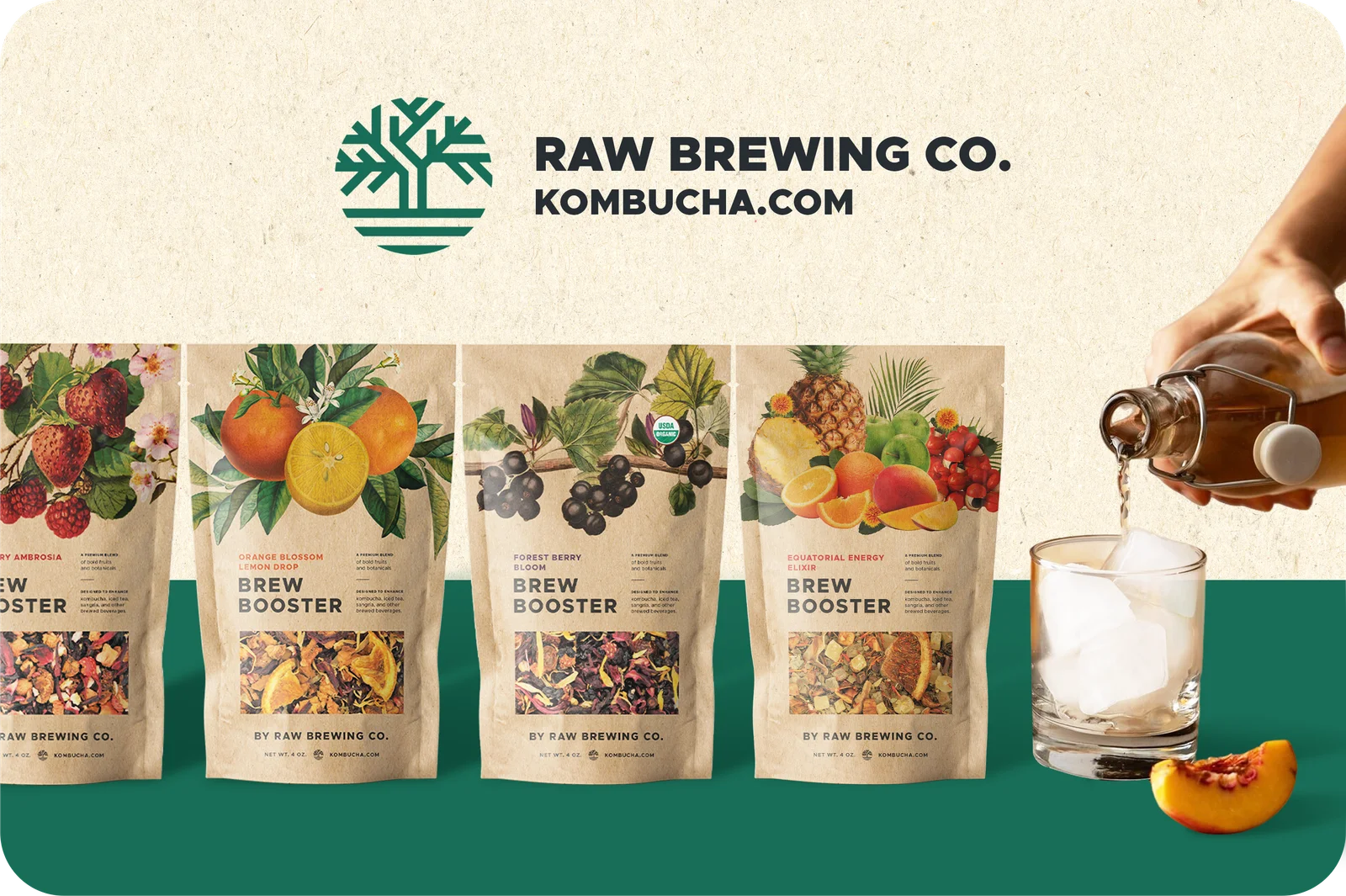
The Setup
Most wellness brands have the opposite problem.
They've got a polished email program — beautiful templates, clean copy, segmented flows — and zero personality. Open one, and you're looking at the same "thanks for subscribing" sequence every other DTC brand sends. The design is fine. The strategy is fine. The brand has just disappeared into a Klaviyo template.
Kombucha.com was the inverse.
They had personality in spades. A founder with a voice. A product category most people don't fully understand. A small, loud community that was already telling people about the brand without being asked. The thing they didn't have yet was the lifecycle system to match.
That's where we came in.
Before: A Brand With a Voice and No Place to Use It
When Kombucha.com hit our inbox, they were past the "do we have a brand" question. The brand existed. It was sharp. The founder, Michael Peter, was already publishing thinking that made the brand feel less like a beverage company and more like a point of view.
What they didn't have was retention infrastructure. Specifically:
- No structured welcome flow. New subscribers got... nothing memorable. A confirmation. Maybe a discount code. The kind of post-signup experience that wastes the moment a customer is most curious about you.
- No customer education layer. Kombucha isn't beer. It isn't soda. People who buy it for the first time genuinely don't know what they just bought — and that uncertainty kills repeat purchase. It's a massive opportunity, and it was being left on the table.
- No system designed for growth. The list was small. But what was there wasn't built to scale. As the brand grew, the customer journey would fragment.
The problem wasn't "we need more emails." It was "we need a retention foundation that actually sounds like us — before growth makes it impossible to build cleanly."
That's a very different conversation. And it's the right one to be having at this stage.
The Decision That Shaped Everything
There's a pattern we see with founder-led brands at this point in their growth. The team gets nervous about how casual the brand feels. They worry that as they get bigger, the voice needs to "mature." So they hire someone who writes the email program in a corporate tone, and the brand quietly becomes forgettable.
We pushed back hard on that.
The reason Kombucha.com worked at all was the founder voice. Strip that out and you have a kombucha brand that sounds like every other kombucha brand. That's a wholesale identity transplant — and it's the wrong call almost every time.
So we made the early decision to lean further into what was already working: community-first onboarding, founder-led copy, playful but structured pacing, and an aesthetic that felt earthy and rebellious instead of clean and corporate.
Once that decision was made, the rest of the work got easier.
After: The 7-Email Welcome Flow
The welcome flow we built doesn't open with "thank you for subscribing." It opens with a point of view — about fermentation, about what most people get wrong about kombucha, about why this brand exists in the first place. Then it walks subscribers through a real onboarding arc: brand → category → community → product → conversion.
Here's what each email does and why it's there.
Email 1 — Welcome
Sets the tone in the first three seconds. No corporate "thanks for joining" copy. Personality forward. The job of this email isn't to sell — it's to make sure the next six get opened.

Email 2 — Brand Story
This is where the founder voice does the heavy lifting. Why this brand exists. What it stands for. What it refuses to do. It reads less like marketing and more like a manifesto — because at this stage of a brand, that's the only thing that creates an emotional bond before the first sip.

Email 3 — The Kombucha.com Difference
Most welcome flows skip this beat. They assume the customer already knows what makes the product different. Wrong assumption — especially in a crowded category. This email makes the case for why Kombucha.com specifically, in language that doesn't sound like a spec sheet.

Email 4 — Intro to Raw U & Ferm Forum
The community email. Instead of a "follow us on Instagram" CTA, we route subscribers into the actual educational hub and community the brand had built around fermentation. This is the moment a subscriber stops being a list contact and starts being part of the world.

Email 5 — Home Brewing Tips and Tricks
Real value, no pitch. Teaching the subscriber something they actually wanted to know is how you earn the next open. It also signals confidence — only a brand that knows its product can give away this much information for free.

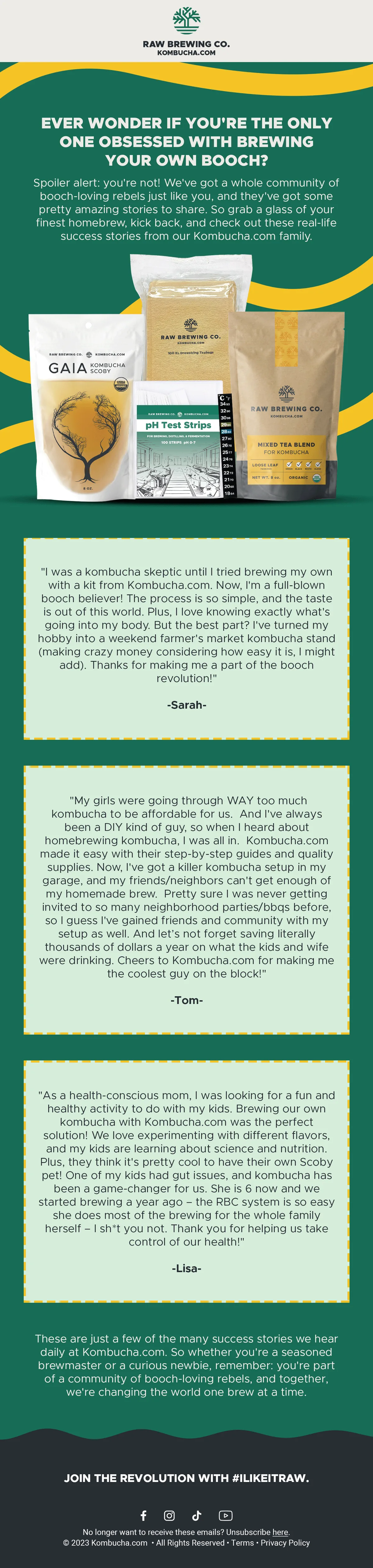
Email 6 — Real People, Real Booch, Real Good
Social proof, the right way. Not five-star Trustpilot screenshots. Actual humans, actual stories. This is where the community work in Email 4 starts paying off — the subscriber sees themselves in the people already drinking the product.
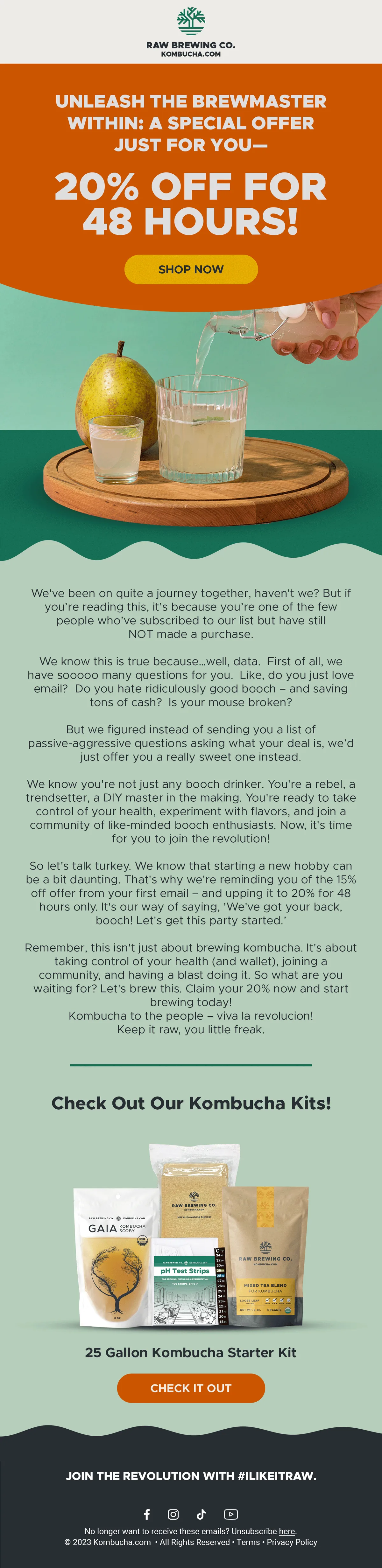
Email 7 — Last Call: 20% Off for 48 Hours
Now — and only now — the conversion ask. By the time this email lands, the subscriber has been welcomed, given the brand story, taught the category, invited into the community, given real value, and shown social proof. The discount isn't bribing them to buy. It's removing the last bit of friction from a decision they're already leaning toward.
That's the bar.
The Design System
Copy was half the job. The visual system carried the rest.
We built around earthy tones — muted greens, warm neutrals, off-whites — paired with lifestyle photography that showed the product in context, not on a sterile white background. The layout was clean enough to scan in three seconds but loose enough to feel like a brand designed by humans, not a checkout page wearing email clothes.
The design rule was simple: it should feel energetic, not loud. Educational, not preachy. Branded, not over-art-directed.
Every email could stand alone as a small piece of brand storytelling. Stacked together, they became the foundation for how Kombucha.com talks to customers.
The Foundation We Built For
A welcome flow is the start, not the end. The deeper work was setting up the lifecycle architecture so it could grow without breaking.
That meant the welcome flow was built knowing it would plug into:
- Abandoned cart sequences
- Post-purchase nurture
- Cross-flavor education
- Replenishment reminders
- Win-back flows when subscribers go quiet
- Community-driven re-engagement
We didn't build all of it on day one. But we built the welcome experience knowing the rest was coming. Segmentation hooks, identity tags, behavioral signals — the wiring was in place so that when the brand was ready to layer on more lifecycle moments, nothing had to be rebuilt from scratch.
This is the part most agencies miss. They build the welcome flow as a one-off project. We build it as a foundation. That's the difference between a campaign and a proper email and SMS marketing operation.
What the Founder Said
"What sets Mark and his team apart is the quality of design work. They were on point with follow-up and keeping the ball rolling. These guys do high-quality work and don't need to be babysat."
— Michael Peter, Founder, Kombucha.com
That second sentence matters more than the first.
Most agency engagements at this stage of a brand die not because the work is bad, but because the founder ends up project-managing the agency. We don't operate that way. You hand us the brand, we ship the work, and you get to keep running your company.
The Takeaway
When a brand has a voice this strong, the wrong move is to "professionalize" it. The right move is to build the lifecycle system around the voice — not on top of it.
Kombucha.com is one of our favorite examples of how a clear founder identity, when treated as an asset instead of something to be cleaned up, becomes the most efficient retention engine a brand can have.
Want a retention system that actually sounds like your brand? Book a free strategy call or see how we've done it for other brands.